
Top Stock Gainers
The Daily Runners Archive
The market's single biggest gainer, logged every day with the numbers that actually happened and the real reason behind the move. Sort it, filter by why it ran, or search a ticker you remember to see if it is a previous runner.
Last updated November 25, 2026
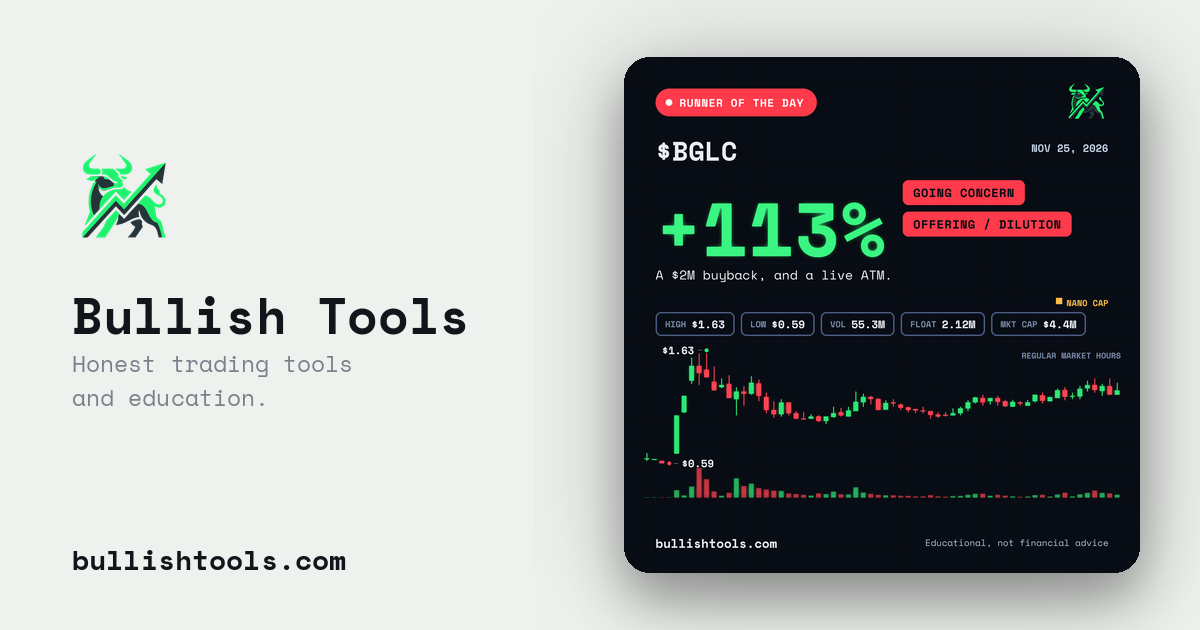
Every trading day, one stock tops the leaderboard for percent gained. I log it here with the open, close, high, low, volume, float, and market cap, then tag why it moved so you can filter the whole archive by reason. The gain is measured close to prior close, the way the top-gainer lists you see everywhere calculate it. Here is how I pick the Runner of the Day, and why it may not match every list you see.
One honest note that matters: a headline percent can lie. On a reverse-split day a stock can show a triple-digit gain that mostly reflects the split, not real buying. When that happens I flag it, and the runner's lesson walks through the split-adjusted picture bar by bar. Numbers are the regular session; the lesson covers anything that happened before the open or after the close. This is a record for learning patterns, not a buy list, and nothing here is financial advice.
Browse the runners (126 logged)
| Ticker ↕ | Gain ↕ | Date ↕ | Close ↕ | High | Low | Volume ↕ | Float ↕ | Mkt cap ↕ | Sector | Why it moved |
|---|---|---|---|---|---|---|---|---|---|---|
| $BGLC Nano Lesson | +113% | Nov 25, 2026 | $1.26 | $1.63 | $0.59 | 55.34M | 2.12M | $4.4M | Health Care | News Low Float Faded Offering |
|
Catalyst BioNexus Gene Lab announced a $2 million stock repurchase program on November 25, authorized by its board on November 23 (Benzinga headline: BioNexus Board Authorizes $2M Share Buyback). The announcement came through a GlobeNewswire release, not an SEC filing. A Schedule 13G and a Form 3 accepted that morning report Ruanyun Edai Technology holding 560,000 shares, 16.03 percent, but those are newly issued shares the company agreed to hand over as payment for a technology licence, not stock bought on the open market. A stock that traded 3,501 shares on Tuesday traded 55.3 million on Wednesday. BioNexus has a 2.1 million share float, so that is more than 24 times every freely traded share. It did not print at all until 10:05, sat at the prior close until 10:35, then ran to $1.63 by 11:20 and spent the rest of the day handing it back, closing at $1.26. The company authorized a $2 million buyback against a float worth about $1.25 million at Tuesday's close. Its 10-Q, filed six days earlier, carries a going concern warning. On a book this thin, the size of the news matters less than how few shares exist to absorb it. |
||||||||||
| $JAGX Nano Lesson | +109% | Nov 24, 2026 | $12.80 | $14.70 | $6.60 | 12.28M | 530K | $6.83M | Health Care | Reverse Split Low Float Offering |
|
Catalyst Jaguar Health's 1 for 25 reverse split, announced November 20, took effect at 12:01 am ET on November 24 and cut the share count to about 534,000 shares. A Napo Pharmaceuticals release on completing process validation batches of lyophilized crofelemer crossed shortly after 9 am ET the same morning, but the run did not begin until 10:55 am and I found nothing that ties the two together. Since November 9 its existing at-the-market program with Ladenburg Thalmann has also had up to $75 million of new capacity on file, so new shares could be sold at market prices from time to time. Jaguar Health's 1 for 25 reverse split took effect at 12:01 am on November 24 and left about 534,000 shares outstanding. Only 117,913 shares traded in the first 85 minutes, then it ran from $8.63 at 10:50 am to $14.62 by 11:20 am, gave back 33% from the high by 12:05 pm, and closed at $12.80, up 109%. Volume was 12.3 million shares, roughly 23 times the float. The lesson for me is that the share count cuts both ways. A tiny float is why price could travel that far that fast. The company also had $75 million of new at-the-market capacity on file, so new shares could be sold at market. I can't say any were sold that day. |
||||||||||
| $WETO Lesson | +239% | Nov 23, 2026 | $0.54 | $0.78 | $0.50 | 311.75M | — | — | Industrials | No Fresh News Faded Offering |
|
Catalyst No catalyst dated November 23 could be verified, and EDGAR full text search returns nothing filed on November 20, 21, 22 or 23. The most recent filings were a 6-K filed November 19 reporting the chief technology officer's resignation effective November 18 and a 6-K filed November 17 appointing two co-chief operating officers, neither of which explains the move, and the regular session was the aftermath of a run that had already happened in Friday's after-hours session. |
||||||||||
| $NXAT Lesson | +144% | Nov 20, 2026 | $0.55 | $0.82 | $0.45 | 359.76M | — | — | Communication Services | Delisting Notice No Fresh News Faded Offering |
|
Catalyst No catalyst dated November 20 could be verified. What is documented is that Nasdaq's November 17 Staff Delisting Determination set the opening of business on November 20 as the date trading in the shares and warrants would be suspended unless the company requested an appeal by November 18, and the stock instead traded a full session on 359.8 million shares, 816 times the prior day's volume. |
||||||||||
| $VIVS Nano Lesson | +142% | Nov 19, 2026 | $0.29 | $0.32 | $0.17 | 815.95M | 19.84M | $5.91M | Health Care | News |
|
Catalyst VivoSim Labs announced before the open, on its own GlobeNewswire wire, that it signed a seven-figure agreement with an unnamed top-10 global pharmaceutical company for NAMkind liver and intestinal toxicology testing, and said it expects to exceed its previously issued 500%+ revenue growth guidance for fiscal 2027. |
||||||||||
| $SVRE Nano Lesson | +111% | Nov 18, 2026 | $0.86 | $1.15 | $0.68 | 163.8M | 2.5M | $2.16M | Information Technology | Low Float No Fresh News Faded |
|
Catalyst No verified catalyst. SaverOne has filed nothing with the SEC since a 6-K accepted October 26 announcing a software-only driver safety product, and no press release carries the session date, so the honest label is no fresh news rather than a guess. |
||||||||||
| $SLS Mid Lesson | +156% | Nov 17, 2026 | $19.15 | $24.89 | $16.70 | 120.29M | 202M | $3.9B | Health Care | FDA / Data Offering Halted Faded |
|
Catalyst SELLAS Life Sciences reported positive pivotal Phase 3 REGAL results for galinpepimut-S in acute myeloid leukemia, with median overall survival of 24.0 months versus 14.7 months for best available treatment, a hazard ratio of 0.59 and two sided p=0.035 in 126 patients, disclosed in an 8-K accepted at 7:14am ET while the stock was halted news pending. |
||||||||||
| $GMM Micro Lesson | +97% | Nov 16, 2026 | $2.01 | $4.81 | $1.40 | 112.81M | 57.7M | $116.08M | Information Technology | News Offering Faded |
|
Catalyst Global Mofy AI announced before the open, at 8:32 am ET, that it had made an indirect investment in Anthropic in September 2026 through a subscription to an investment fund, disclosing no dollar amount and no stake size. |
||||||||||
| $FCUV Nano Lesson | +136% | Nov 13, 2026 | $7.08 | $8.32 | $5.03 | 117.44M | 881K | $6.95M | Information Technology | No Fresh News Low Float Faded |
|
Catalyst No dated catalyst. EDGAR shows nothing filed after the routine 10-Q on November 10 and the company has issued no press release since September 5, so there is no verifiable reason for the move. |
||||||||||
| $POAS Nano Lesson | +234% | Nov 12, 2026 | $3.01 | $5.60 | $2.03 | 100.46M | 219K | $6.34M | Health Care | No Fresh News Low Float Faded Offering |
|
Catalyst No dated catalyst. Nothing was filed with the SEC after October 26 and no company news ran on November 11 or 12, so there is no verifiable reason for the move. |
||||||||||
| $NXXT Nano Lesson | +811% | Nov 11, 2026 | $1.70 | $3.74 | $0.20 | 150.57M | 783K | $2.86M | Energy | Delisting Notice Low Float Faded |
|
Catalyst The Nasdaq Hearings Panel denied NextNRG's request to continue its listing, and on November 11 at 3:50pm ET the company announced that trading would be suspended at the open on November 12 and that its shares were expected to be quoted on OTC Markets, making this the stock's last full session on the exchange. |
||||||||||
| $SMX Nano Lesson | +105% | Nov 10, 2026 | $19.25 | $21.50 | $11.83 | 30.65M | — | $17.28M | Information Technology | News Low Float Reverse Split |
|
Catalyst A 6-K accepted at 9:31am ET on November 10 attached a press release dated the same day announcing SMX SCI, an AI powered scientific intelligence platform the company says will begin internal rollout in the first quarter of 2027, and the stock had already gapped 92 percent before that filing landed. |
||||||||||
| $WCT Nano Lesson | +92% | Nov 9, 2026 | $4.47 | $6.67 | $1.96 | 17.3M | 1.02M | $5.46M | Information Technology | Reverse Split Low Float No Fresh News Faded |
|
Catalyst A 1-for-10 reverse split of the Class A shares took effect this session, cutting the tradable float to about 1 million shares; no news dated November 9 was found. |
||||||||||
| $SDA Nano Lesson | +144% | Nov 6, 2026 | $0.38 | $0.48 | $0.15 | 539.39M | 38.91M | $38.41M | Information Technology | News Faded |
|
Catalyst Two separate company announcements: preliminary unaudited nine month revenue of about $426.4 million, up 26% year over year, with net income of $5.8 million against a $4.1 million loss a year earlier, released at 7:30 am ET, followed at 9:30 am ET by a board authorised repurchase program of up to $10 million of Class A ordinary shares, furnished on a 6-K that EDGAR accepted at 10:21 am ET. |
||||||||||
| $LABT Lesson | +182% | Nov 5, 2026 | $0.54 | $0.96 | $0.37 | 753.75M | — | — | Health Care | News Faded |
|
Catalyst Announced at 8:02 am ET that it had completed the redemption of all remaining Series C convertible preferred stock, 127,097 shares for $1,270,970 in cash, leaving no preferred stock outstanding and no debt for borrowed money. |
||||||||||
| $OMH Lesson | +432% | Nov 4, 2026 | $15.55 | $18.23 | $2.93 | 93.41M | — | — | Real Estate | Offering No Fresh News Low Float |
|
Catalyst No company release or SEC filing on November 3 or 4; on file were an October 7 standby equity purchase agreement for up to $40 million priced at the lower of $1.26 or 50% of the lowest close of the prior 180 trading days, and an October 16 placement of 3,000,000 Class A shares with 3,000,000 warrants at $1.30 that carry an alternate cashless exercise for nine shares per warrant. Ohmyhome traded 380 shares before the open on November 4 and opened flat at $2.99. Within an hour it was over $8, and by noon it touched $12.58. Then it collapsed to $3.03 by 2:10. In the last hour it ran again, to $18.23 at 3:50, and closed at $15.55, up 432%. After hours it touched $18.88. I found no news that day. The filings showed a $40 million equity line priced at half or less of the market and an October placement at $1.30 with warrants that could turn into nine shares each. On a stock this thin, the filings tell you more than the tape. |
||||||||||
| $CHSN Nano Lesson | +241% | Nov 3, 2026 | $3.38 | $4.15 | $1.05 | 90.9M | 2.1M | $7.85M | Consumer Staples | Low Float No Fresh News |
|
Catalyst No dated catalyst found: no press release and no SEC filing on the session date, the most recent being an October 27 6-K reporting shareholder approval of a second 100-for-1 share consolidation and a large increase in authorised share capital. |
||||||||||
| $INO Micro Lesson | +213% | Nov 2, 2026 | $1.89 | $2.17 | $1.66 | 222.26M | 103.01M | $195.42M | Health Care | FDA / Data Faded |
|
Catalyst The FDA granted accelerated approval to VOCERYQ (doruxapapogene ralaplasmid and lalikinogene sifuplasmid-gxfd, formerly INO-3107), an immunotherapy to reduce the frequency of surgery in adults with recurrent respiratory papillomatosis. INOVIO announced it on Friday October 30, 2026, about 30 minutes after the closing bell. It is the company's first approved product. |
||||||||||
| $ONEG Nano Lesson | +108% | Oct 30, 2026 | $1.63 | $1.79 | $0.86 | 109.7M | 7M | $26.08M | Industrials | Low Float No Fresh News |
|
Catalyst No dated catalyst was found: nothing has been filed on EDGAR since August 31, 2026, there has been no company press release since the July 23 annual results for the fiscal year ended March 31, 2026, and no company specific news item carries the session date, so the move is stamped NO FRESH NEWS. |
||||||||||
| $BURU Lesson | +115% | Oct 29, 2026 | $0.37 | $0.48 | $0.22 | 936.65M | — | — | Industrials | News Offering Faded |
|
Catalyst NUBURU said at 8:30 am ET on October 29 that NYSE American had restored its compliance with the continued listing standards, citing an NYSE Regulation letter dated October 29 that resolved deficiencies under Sections 1003(a)(i) and 1003(a)(ii), on the same day the compliance plan accepted in July 2025 expired (Business Wire release, October 29, 2026). |
||||||||||
| $ULBI Micro Lesson | +145% | Oct 28, 2026 | $15.61 | $15.67 | $15.60 | 2.5M | 16.13M | $260.11M | Industrials | Contract / Deal News |
|
Catalyst After the close on October 27, 2026, Ultralife agreed to be acquired by EnerSys for $16.00 per share in cash, and EnerSys filed its tender offer for the shares on October 28. Ultralife was up 145% on the day, but the move was over before the session started. EnerSys agreed to buy the company for $16.00 a share in cash after Tuesday's close, and in that evening's after hours the stock jumped from $6.43 to $17.10 within minutes. By Wednesday's open it was parked near $15.60. The whole regular session traded between $15.60 and $15.67 and closed at $15.61, just under the deal price. That's the lesson I take from it: a cash buyout caps the stock near the offer, so the biggest number on the gainers list can be the one with nothing left to trade. |
||||||||||
| $BRAI Small Lesson | +56% | Oct 27, 2026 | $3.31 | $4.16 | $3.00 | 51.79M | — | $682.15M | Information Technology | No Fresh News Faded |
|
Catalyst No new release or filing on October 27; the move was day two of Braiin's Monday, October 26 announcement of Force AI, a layer that lets its RADIUS contact-center platform run on any major large language model (Monday the stock spiked to $5.05 and closed down 40% at $2.12). The release was filed on a 6-K on October 28. Braiin announced its Force AI platform on Monday, October 26. The stock spiked to $5.05 that day and then closed down 40% at $2.12. Tuesday brought no new release. It opened up 52% at $3.23, climbed to $4.16 by 1:00 pm, and slid in the last 40 minutes to close at $3.31, up 56%. After hours it ran to $5.20. Two huge days in opposite directions, on one press release. The lesson for me: day two of a story can move as much as day one, and the after-hours session can be where the real high is. |
||||||||||
| $SGRY Mid Lesson | +47% | Oct 26, 2026 | $23.25 | $23.29 | $22.94 | 58.82M | — | $3.04B | Health Care | Contract / Deal |
|
Catalyst Surgery Partners agreed on October 23 to be acquired by HealthSpan Partners, a contractual affiliate of Bon Secours Mercy Health, for $23.50 per share in cash (about $5.7 billion enterprise value, with Bain Capital's roughly 39% stake rolling over); the 8-K and joint release were accepted at 9:03 am ET on October 26, after a premarket Financial Times report of late-stage talks. Surgery Partners agreed to be bought for $23.50 a share in cash, announced at 9:03 am on October 26 after a Financial Times report of sale talks. Friday's close was $15.75. Premarket traded near $19.50, and the regular session did not trade until 9:55, when it opened at $23.03. It never left a 35-cent range and closed at $23.25, up 47%. This is the same lesson as Silence Therapeutics a week earlier. A cash deal price is a ceiling, and a big percentage made in the gap leaves nothing to trade. |
||||||||||
| $CLRO Nano Lesson | +69% | Oct 23, 2026 | $3.25 | $4.69 | $1.97 | 36.62M | — | $8.7M | Information Technology | Delisting Notice No Fresh News Low Float Faded |
|
Catalyst No company release or SEC filing on October 22 or 23 (EDGAR shows nothing between an October 15 8-K and a November 6 Schedule 13D/A); on file were an October 8 Nasdaq Staff delisting determination for the stockholders' equity rule, appealed with a hearing set for November 17, and a pending S-1 (amended September 4) for a best-efforts offering of units with warrants needed to close the July 1 merger agreement with Cortigent. ClearOne opened flat at $1.97 on October 23 with no news. By 10:10 it had spiked to $4.685, up 144%, with several gaps in the tape that looked like volatility halts. Within 35 minutes it was back at $2.65. It closed at $3.25, up 69%, and after hours briefly ran to $4.67 again. Two things were on file: a Nasdaq delisting determination under appeal, and a pending offering of units with warrants needed to close its Cortigent merger. With about 2.7 million shares, it moved fast in both directions. |
||||||||||
| $TANH Nano Lesson | +181% | Oct 22, 2026 | $24.83 | $28.25 | $8.01 | 2.21M | — | $16.58M | Materials | No Fresh News Low Float |
|
Catalyst No company release or SEC filing on October 21 or 22; the most recent 6-K (October 2) covered a board change. Tantech had completed a 1-for-50 reverse split on September 3, 2026, cutting 33,382,332 shares to roughly 668,000, and Nasdaq confirmed on September 21 that it had regained compliance with the bid price rule. Tantech barely traded for most of October 22. Before 1:10 pm the regular session had printed only about 18,000 shares, near $8 to $9. Then it ran from $8.41 to $28.25 by 3:40 and closed at $24.83, up 181%. After hours it reached $35.91. I found no filing and no press release. A 1-for-50 reverse split in September had cut the share count to roughly 668,000. With that few shares, it takes very little buying to move the price, and very little selling to move it back. |
||||||||||
| $SHFS Lesson | +71% | Oct 21, 2026 | $0.15 | $0.18 | $0.12 | 571.96M | — | — | Financials | News Offering Faded |
|
Catalyst SHF Holdings announced after the close on October 20 (8-K accepted 4:45 pm ET) that Nasdaq granted a second 180-day period, to April 19, 2027, to regain compliance with the $1.00 minimum bid price rule; on file were a $150 million equity line with CREO Investments priced at 90% of the lowest intraday price and Series B convertible preferred stock, whose $18.6336 conversion price was cut to $0.1210 on October 22, the next day. SHF Holdings got a second 180-day Nasdaq extension to lift its price above $1.00, announced after the close on October 20. The stock had fallen from $1.18 to under 9 cents in under three weeks. It opened up 71% at $0.1538, hit $0.177 in the first five minutes, sank to $0.1153 by 10:35, and closed at $0.1542, up 71%. The whole gain was the gap. On file was an equity line priced below the market, and the next day a convertible preferred's conversion price was cut to about 12 cents. An extension buys time; it does not fix the share price. |
||||||||||
| $SAIQ Lesson | +100% | Oct 20, 2026 | $6.84 | $6.92 | $4.52 | 58.09M | — | — | Information Technology | News Offering |
|
Catalyst WISeSat.Space announced the successful launch and deployment of FOSSASAT-2E27, a 6U satellite carrying SEALSQ VaultIC security hardware, aboard SpaceX's Falcon 9 Bandwagon-5 mission (WISeSat.Space and SEALSQ release via GlobeNewswire, October 20; the exact release time could not be confirmed). |
||||||||||
| $SLN Small Lesson | +125% | Oct 19, 2026 | $19.58 | $19.61 | $19.56 | 71.92M | — | $1.22B | Health Care | Contract / Deal |
|
Catalyst Merck KGaA, Darmstadt, Germany agreed to acquire Silence Therapeutics for $20.00 in cash per ADS ($6.6667 per ordinary share), about $1.3 billion in equity value, by a UK scheme of arrangement; the 8-K was accepted at 8:05 am ET on October 19 and closing was expected in the first quarter of 2027. Silence Therapeutics topped my screener on October 19, and there was almost nothing to trade. Merck KGaA agreed to buy it for $20.00 cash per ADS, and the filing landed at 8:05 am. Friday's close was $8.68. Monday's regular session opened at $19.585 and traded between $19.56 and $19.61 all day. It closed at $19.58, up 125%. A cash deal price is a ceiling. Once $20.00 is on the table, the stock trades on whether the deal closes, not on momentum. A screener ranks by percentage, and percentage is not opportunity. |
||||||||||
| $XLAB Micro Lesson | +72% | Oct 16, 2026 | $2.35 | $3.84 | $1.75 | 171.62M | — | $151.19M | Information Technology | No Fresh News Faded |
|
Catalyst No new filing or release on October 16; the move was day two of an 8-K accepted Wednesday, October 14 at 8:17 pm ET disclosing an $8,208,000 agreement to sell Sunon Inc. twelve NVIDIA HGX B300 GPU servers plus 36 months of IT operations (Thursday was the first reaction, +49%). Exascale Labs ran on day two of its own news. A Wednesday night filing disclosed an $8.2 million GPU server sale, and Thursday the stock rose 49%. On Friday it opened at $1.85, dipped to $1.75, then more than doubled to $3.84 by 10:10. That was the top. It spent the rest of the day giving it back and closed at $2.35, up 72% but 38% below the high. Nothing new came out that day. The lesson for me: on day two of a story, the high can come early, and everything after it can be a slow fade. |
||||||||||
| $ESLA Nano Lesson | +68% | Oct 15, 2026 | $0.54 | $0.85 | $0.30 | 63.11M | 17.22M | $23.28M | Health Care | No Fresh News Faded |
|
Catalyst No catalyst appeared during the regular session: the whole move ran from 2:35pm to 3:10pm ET with no dated company news, and the only Estrella release of the day, reporting the first STARLIGHT-1 dose-expansion patient to receive two EB103 infusions, crossed Business Wire at 6:45pm ET, nearly three hours after the close and three and a half hours after the $0.85 high. |
||||||||||
| $GLND Micro Lesson | +76% | Oct 14, 2026 | $3.90 | $4.48 | $3.41 | 175.01M | 30.13M | $170.55M | Energy | News Faded |
|
Catalyst A Truth Social post by President Trump on October 14 2026 saying large-scale oil, gas and mineral exploration was preparing to begin in Greenland repriced the whole Greenland-exposed complex, lifting GLND, GRML and CRML together; Greenland Energy itself issued no announcement that day. |
||||||||||
| $JBDI Nano Lesson | +243% | Oct 13, 2026 | $3.43 | $9.50 | $1.98 | 92.63M | 3.48M | $32.63M | Industrials | Contract / Deal Low Float Faded Halted |
|
Catalyst A 6-K disseminated at 8:55am ET on the session date disclosed a share purchase agreement dated October 12 2026 under which JBDI acquires Glorian Capital Ltd, the British Virgin Islands parent of ZYMIX developer Flicknmix Ltd, for $900,000,000 paid entirely in perpetual zero-coupon convertible promissory notes converting at $1.00 per ordinary share. |
||||||||||
| $MNDR Nano Lesson | +257% | Oct 12, 2026 | $3.04 | $5.67 | $2.30 | 192.51M | 496K | $3.63M | Health Care | Low Float No Fresh News Faded |
|
Catalyst No company news and no SEC filing on the session date; the newest filing for CIK 1976695 is a 6-K accepted September 24 2026 disclosing a board-approved compensation share issuance, the newest press release is dated August 10 2026, and Benzinga's premarket movers list carried MNDR with no stated reason, so no identifiable catalyst exists for the move. |
||||||||||
| $WFF Small Lesson | +499% | Oct 9, 2026 | $12.29 | $19.44 | $1.75 | 146.06M | 38.48M | $515.2M | Materials | No Fresh News Offering Faded |
|
Catalyst No fresh news and no filing on the session date; a $30 million standby equity purchase agreement dated July 30, 2026, registered on the company's F-3 shelf, was on file. WF Holding closed up 499% with no news I could find, and it actually went red first. It hit a $1.75 low at 11:10, then climbed in steps, with gaps in the tape that usually mean halts, to $19.44 at 3:05. It closed at $12.29, 36% off that high. What I take from it: a no-news spike still deserves a filings check. A $30 million standby equity purchase agreement, signed in July, let the company sell shares into strength the whole time. |
||||||||||
| $FLYE Nano Lesson | +82% | Oct 8, 2026 | $2.32 | $3.47 | $1.95 | 133.01M | 1.56M | $3.79M | Consumer Discretionary | No Fresh News Low Float Faded |
|
Catalyst No fresh news: I found no company headline from the prior close through that night and no share offering on file; the most recent 10-Q, filed September 1, 2026, carries a going-concern warning. Fly-E Group closed up 82%, and I couldn't find any news behind it. The move started in premarket at 7:20 am and peaked at $3.67 at 8:35, 55 minutes before the open. The first regular-session bar touched $3.47, and that was the top of the session. From there it bled to a $1.95 low at 12:55 and closed at $2.32, a third below its regular-session high. The lesson for me is that on a no-news stock with a tiny share count, the premarket can be the whole move. If I'd been buying the open, I'd have been buying the high. |
||||||||||
| $SXTC Nano Lesson | +126% | Oct 7, 2026 | $2.83 | $9.59 | $1.87 | 146.57M | 880K | $3.74M | Health Care | No Fresh News Low Float Offering Faded |
|
Catalyst No fresh news; a July 3, 2026 pre-paid share purchase agreement for up to $31.5 million was on file (floor price cut back to $0.20 on August 27), the company signed a Regulation S private placement on October 7 that it terminated the next day, and it announced a $1.50 registered direct offering on the morning of October 8. China SXT closed up 126% with no news, and the day swung hard both ways. It fell to a $1.87 low at 11:05, then ran to $9.59 at 2:00, up 667% from the prior close, and closed at $2.83, 70% off the high. The lesson for me is in the filings. A $31.5 million prepaid share purchase deal was on file with its floor price cut back to $0.20, the company signed a private placement that day, and the next morning it announced a $1.50 offering. |
||||||||||
| $OLB Nano Lesson | +117% | Oct 6, 2026 | $0.41 | $0.49 | $0.19 | 765.75M | — | $12.79M | Information Technology | News Offering Faded |
|
Catalyst At the open on October 6, 2026, OLB Group announced a board authorization to repurchase up to 1,000,000 shares and said it had suspended its at-the-market offering program effective immediately. OLB Group closed up 117% after it paused its at-the-market offering and authorized a buyback of up to 1,000,000 shares, right at the open. It ran in three pushes to $0.4896 at 12:30 and closed at $0.41, then lost another 27% after hours. The buyback was only about 3% of the company, yet the stock traded more than 765 million shares. For me the lesson is that a pause is not an ending: the ATM had been selling shares that quarter and could be turned back on. |
||||||||||
| $MI Nano Lesson | +682% | Oct 5, 2026 | $7.00 | $10.42 | $2.02 | 166.95M | 402K | $3.58M | Information Technology | No Fresh News Offering Low Float Faded |
|
Catalyst No company catalyst: during the session, at 2:25 pm ET on October 5, NFT Limited filed a 6-K under NYSE American Company Guide Section 401(d) saying it was not aware of any undisclosed information or business development that would account for the trading. NFT Limited ran from under a dollar to $10.42 on a day the company itself said it knew of no reason for the move. About 166.9 million shares traded against a float of roughly 400,000, and a pending sale of 80 million new shares at $0.45 was already on file. It closed at $7.00, up 682% but 32% off the high, and after hours took it down another 35% to $4.54. What it taught me: a statement that there is no news is not a catalyst, and a float that small can move with nothing behind it. |
||||||||||
| $AMOD Lesson | +198% | Oct 2, 2026 | $3.49 | $4.77 | $3.08 | 194.46M | 577K | — | Information Technology | Offering Low Float Faded |
|
Catalyst A bitcoin funded private placement: in an 8-K accepted at 11:30 am ET on Thursday, October 1, the company said it closed the deal on September 30, issuing 51,621,560 new Class A shares plus warrants for 51,621,560 more at $4.36 in exchange for 3,170 bitcoin, against 4,929,766 shares outstanding as of the August 25 record date. A second 8-K before Friday's open (8:35 am ET) said Nasdaq had confirmed its equity compliance. Alpha Modus swapped 51.6 million new shares and matching warrants for 3,170 bitcoin, and the filing landed at 11:30 am on Thursday. The stock still closed that day at $1.17, then ran after hours and opened Friday at $3.48, up 197%. The high of $4.77 came by 9:45, and the rest of the day was a slow bleed back to a $3.49 close, 26% off the high. Almost the whole gain was in place before the bell. What it taught me: when the gap does all the work, the regular session may have nothing left to add. |
||||||||||
| $SSM Nano Lesson | +97% | Oct 1, 2026 | $2.21 | $2.58 | $1.11 | 50.48M | 1.05M | $3.78M | Consumer Discretionary | Low Float Offering |
|
Catalyst No company news. The only dated item was a Schedule 13D from Alpine Fox Capital, accepted at 1:25 pm ET on October 1, disclosing a 21.5% stake (315,295 shares) bought for investment purposes; the stock broke out in that same five-minute bar. A registered direct offering of 283,500 shares at $2.67 had been filed September 2. Sono Group sat at $1.12 for four hours and traded about 35,000 shares. At 1:25 pm a fund filed a 13D showing a 21.5% stake, and the stock broke out in that same five-minute bar. It reached $2.58 just before the close, finished up 97% at $2.21 on about 35 times its float, and ended after hours even higher at $2.62. I can show the timing, not the cause. What it taught me: a float near a million shares can turn one filing into a runner, even with a $2.67 registered direct from September still on file. |
||||||||||
| $NIVF Nano Lesson | +133% | Sep 30, 2026 | $0.17 | $0.26 | $0.15 | 859.17M | — | $490K | Health Care | Offering Low Float Faded |
|
Catalyst Closed a $1.25 million best-efforts public offering at $0.07 a share, after falling 79% the prior session to reach that price. NewGenIvf had just fallen 79% to price a $1.25 million offering at $0.07. On the day it closed, the stock ran to $0.2805 by 4:35 am, up 289%, and that turned out to be the high of the day. The open brought a second spike to $0.2575, then a fade to a $0.168 close, still up 133%. Pre-funded warrants for 17.7 million shares came with the deal, against 2.8 million Class A shares. What it taught me: a rebound off a discounted offering price can be fast, and the premarket high can be the whole day. |
||||||||||
| $SDEV Micro Lesson | +108% | Sep 29, 2026 | $3.27 | $3.93 | $1.62 | 192.55M | 5.14M | $169.23M | Financials | No Fresh News Offering Low Float Faded |
|
Catalyst No company catalyst: after the close on Tuesday, September 29 (8-K accepted 4:17 pm ET), Stablecoin Development said it was not aware of any material non-public information, pending transaction or undisclosed development that could explain the unusual trading in its stock. Stablecoin Development opened at $1.64, climbed all morning, broke out at 11:05 and topped at $3.93 at 12:45. After the close the company said in an SEC filing that it knew of no reason for the move. It closed up 108% at $3.27, 16% below the high, on more than 30 times the float Webull reports, then lost 21% after hours. A $100 million at-the-market program was on file the whole time. What it taught me: no news plus a supply of shares waiting to be sold is a combination I treat with caution. |
||||||||||
| $KNRX Nano Lesson | +304% | Sep 28, 2026 | $1.23 | $1.60 | $0.32 | 291.22M | 14.05M | $37.42M | Information Technology | Offering News Faded |
|
Catalyst A 6-K accepted at 1:21 pm ET, while the stock was not trading, announced a planned carve-out of the AscendX Media Technologies subsidiary with outside capital, with no definitive agreements signed. Most of the move came earlier, with no headline found. An F-1 registering up to 156,787,119 Class A shares for an equity line with up to $50 million of company sales had been declared effective Friday September 25. KNRX opened at 32 cents, just 5% over Friday's close, so no gapper scan would have shown it. Then it ran to $1.39 in half an hour with no headline I could find, stopped trading for nearly two hours, and only during that pause did a carve-out filing come out. It closed at $1.23, up 304%, and gave back 30% after hours. The lesson I take from it is to read what was already on file. An equity line letting the company sell up to 156.8 million new shares, about five times its share count, had gone effective the Friday before. |
||||||||||
| $MSGY Nano Lesson | +309% | Sep 25, 2026 | $8.07 | $11.42 | $1.97 | 56.13M | 807K | $17.11M | Industrials | No Fresh News Low Float Faded |
|
Catalyst No fresh news. No press release or SEC filing came out on September 25, 2026; the latest item was a 6-K filed at 8:00 am ET on September 24 reporting the CEO's resignation. A securities purchase agreement for a $1.50 private placement with warrants was signed on September 25 but not disclosed until a 6-K on Monday September 28 at 1:30 pm ET. MSGY ran 309% on a day with no news at all. It opened at $2.13, worked up to $5.95 by 11:05, stopped trading for about 50 minutes and came back at $9.52, then hit $11.42. It closed at $8.07 on nearly 70 times its 807,000 share float, spiked to $12.73 after hours and finished the night at $5.86. What I take from it: a float that tiny can run on nothing. And the company signed a $1.50 private placement that same Friday, which nobody outside knew about until Monday. |
||||||||||
| $APUS Nano Lesson | +114% | Sep 24, 2026 | $4.92 | $8.74 | $4.61 | 87.85M | 623K | $7.42M | Health Care | Contract / Deal Low Float Faded |
|
Catalyst Apimeds' wholly owned subsidiary MindWave Innovations announced a 12-month technology services agreement with Singapore-based AQUAE Holdings to build and operate AQUAEChain, a platform for insured ALCI conservation credits, paid in service fees plus a 20% allocation of the credits. The release crossed at 8:30 am ET, the same five-minute bar the stock started moving; the 8-K attaching it was not filed until September 29, after the session. APUS did almost all of its work before the bell. A subsidiary's deal to build a conservation credits platform hit in the 8:30 premarket bar, and the stock went from $2.28 to about $7 before the open. It printed the regular-session high of $8.74 in the first five minutes and then faded all day to close at $4.92, still up 114% but 43% below the high. The lesson for me: when the gap is already 200%, the open is usually where sellers win. Chasing that first candle was the losing trade. |
||||||||||
| $BENF Nano Lesson | +438% | Sep 23, 2026 | $2.90 | $3.15 | $1.44 | 295.02M | 2.21M | $44.82M | Financials | News Low Float Halted Offering |
|
Catalyst At about 7:32 am ET (8-K accepted 7:35 am) Beneficient announced a strategy to eliminate about $130 million of principal and interest claimed by HCLP Nominees, exchange about $850 million of preferred equity tied to former CEO Brad Heppner for 162,132 Class A shares, and void about $88 million of other obligations, while stating it had not entered into a definitive agreement. A $100 million standby equity purchase agreement with Yorkville was active, with its resale registration effective August 5. BENF was a premarket story. The plan to wipe out debt tied to its convicted former CEO came out at 7:32 am, and the stock went from about 55 cents to roughly $2.90 by the open, up more than 430%. Then the regular session dropped 50% to $1.44 by 10:15, climbed back to $3.14 by noon and closed at $2.90, almost exactly where it opened. What I take from it: on a day like this the gain belongs to premarket buyers. The open was not a bargain, and a $100 million equity line sat on file the whole time. |
||||||||||
| $JAGX Nano Lesson | +1190% | Sep 22, 2026 | $34.46 | $41.53 | $2.75 | 27.95M | — | $17.92M | Health Care | FDA / Data Low Float Halted Reverse Split Offering |
|
Catalyst Jaguar Health announced before the open on September 22 that the FDA waived the 2027 PDUFA fee for Mytesi and that the Center for Veterinary Medicine waived the 2027 fee for Canalevia-CA1; the stock closed up 1190% on a share count of roughly 520,000. |
||||||||||
| $GRML Nano Lesson | +230% | Sep 21, 2026 | $9.42 | $11.68 | $6.63 | 218.34M | 4.35M | $45.31M | Materials | News Low Float Offering Faded Reverse Split |
|
Catalyst Neither catalyst was company financials. On Friday evening September 18 the company issued a release applauding the U.S.-Denmark-Greenland security agreement, and the stock was up 72% in the first premarket bar Monday; then at about 9:30 am ET the company announced it had applied to the Government of Greenland for a new 262 square kilometer license next to its Sarfartoq rare earth project. A $50 million ATM with A.G.P. and a $5.00 best-efforts offering were filed in late August. GRML was up 72% at 4 am Monday after a Friday evening release praising the U.S.-Denmark-Greenland security deal. It opened at $7.31, then dipped to $6.63 instead of running, and only broke out after 10:40, reaching $11.68 at 11:20. It closed at $9.42, up 230%, and kept climbing after hours to $10.93. The lesson I take: check what is on file before chasing a theme. A $50 million at-the-market offering and a $5.00 share offering had both been filed in the four weeks before. |
||||||||||
| $IMCC Nano Lesson | +143% | Sep 18, 2026 | $4.23 | $8.65 | $2.97 | 104.98M | 546K | $2.62M | Consumer Staples | Low Float No Fresh News Faded Offering |
|
Catalyst No dated catalyst found. EDGAR shows no filing after the September 2 convertible-note 6-K, and a news search for the session found no company headline. The mechanism was the float: 104,981,193 shares traded against a free float of 545,979, roughly 192x rotation, three weeks after a 30:1 share consolidation that took shares outstanding to 618,899. IM Cannabis had no news I could find, yet it jumped from about $2 to $4.90 in one five-minute bar at 5:40 am. It faded to $2.90 before the bell, opened at $3.24 and ran to $8.65 by 10:10. The rest of the day was a slide to a $4.23 close, up 143%, and after hours took it down to $3.165. The lesson is the share count. A 30-for-1 consolidation three weeks earlier left a float of about 546,000 shares, and 105 million traded. With a convertible note and warrant filed September 2, a float that small can rip and bleed in the same morning. |
||||||||||
| $AEMD Nano Lesson | +374% | Sep 17, 2026 | $6.78 | $9.50 | $6.01 | 92.6M | 1.59M | $10.88M | Health Care | News Contract / Deal Offering Low Float Faded |
|
Catalyst Verified. Aethlon Medical announced an all-stock merger with North Immunology alongside an approximately $180 million private placement. The 8-K filed 2026-09-17 under Items 1.01, 5.01, 7.01 and 9.01 states that upon the closing of the Merger, on a pro forma basis, pre-Merger North Immunology stockholders (inclusive of investors in the Private Placement) are expected to own approximately 95.25% of the combined company and pre-Merger Company stockholders are expected to own approximately 4.75%. The placement is approximately $146 million in cash proceeds plus approximately $34 million from converting North Immunology's convertible notes and accrued interest. The combined company is to be renamed North Immunology, Inc.; the company press release dated 2026-09-17 says it will trade on Nasdaq under the ticker NRTX, puts pro forma equity value at about $346.5 million, names Bain Capital Life Sciences, Janus Henderson, Deep Track Capital, Longitude Capital and others as investors, and expects closing in the first quarter of 2027. Lead asset NOR-101, a half-life extended anti-IL-13 x IL-18 bispecific antibody for atopic dermatitis. Aethlon Medical announced an all-stock merger with North Immunology at about 6:30 am, with existing holders set to keep about 4.75% of the combined company. The stock went from $1.47 to $9.83 in premarket. It opened at $8.48, hit $9.50 in the first five minutes and faded all day to close at $6.78, up 374%. What I take from it: when big news lands at 6:30, the best prices can be gone before 9:30. The premarket high beat the whole regular session, and the float turned over more than 50 times while the stock drifted lower. |
||||||||||
| $DLXY Nano Lesson | +451% | Sep 16, 2026 | $2.29 | $4.45 | $0.65 | 246.53M | 5M | $37.44M | Energy | News Low Float Faded Halted |
|
Catalyst Verified against the primary release. At 8:00 am ET on September 16 2026 Delixy Holdings announced on GlobeNewswire that it had signed a non-binding letter of intent to acquire up to 48% of the shares of Tarbagatay Munay, which holds the Sarybulak oil field in East Kazakhstan roughly 90 km from the China-Kazakhstan border, from Caog S.a.r.l of Luxembourg. No consideration was disclosed, and the release states that completion is subject to due diligence, a definitive agreement and multiple Kazakh regulatory approvals and that there can be no assurance a definitive agreement will be entered into or the transaction consummated. Delixy announced a non-binding letter of intent at 8:00 am to buy up to 48% of a Kazakhstan oil field operator. It reached $1.31 in premarket, opened at $1.02 and sank to $0.6517 before turning. By 12:40 it hit $4.45, up 972%, with long gaps in the tape that look like volatility halts. Then it reopened far lower and closed at $2.29, up 451% but 48% off the high, and after hours slid to $1.41. The lesson for me: a letter of intent is not a deal, and halts on a 5 million share float can reopen a long way from where they stopped. |
||||||||||
| $RETO Micro Lesson | +676% | Sep 15, 2026 | $2.80 | $4.46 | $0.35 | 232.79M | 35.82M | $103.18M | Industrials | No Fresh News Faded Offering |
|
Catalyst No verifiable catalyst. No SEC filing from the company since August 7, no press release, and nothing dated September 15 in a news sweep. The honest label is no fresh news. ReTo traded fewer than 8,000 shares in premarket and sat at 35 cents for the first hour with no news I could find. At 10:35 the tape woke up, and by 1:45 pm it hit $4.46. It closed at $2.80, up 676%, then spiked to $7.62 in the 4:05 pm bar before ending after hours at $4.33. The lesson is twofold. A dead premarket does not rule a stock out, and the regular-session high is not always the high of the day. A share purchase facility priced at half the market was also on file, which is worth knowing before chasing. |
||||||||||
| $FTFT Micro Lesson | +179% | Sep 14, 2026 | $8.04 | $9.48 | $3.25 | 126.77M | 7.9M | $64.94M | Financials | Low Float No Fresh News Former runner Offering |
|
Catalyst No fresh news. The most recent company filing and release before the session were the August 26 8-K and GlobeNewswire release announcing a 1-for-4 reverse split effective 4:00 pm ET August 28; the day was the fourth leg of a multi-session run on a float of about 7.9 million shares, while a pre-paid share purchase facility with Avondale Capital was converting into stock. Future FinTech had no fresh news, but Monday was day four of a run: it closed at $1.31 on September 8 and $8.04 on September 14, up 513% in five sessions. It opened at $3.30, chopped for hours, broke out at 2:40 and hit $9.48 at 3:40 pm before closing up 179%. After hours it slid to $5.35, a third below the close. What I take from it: a late-day high on day four is a different trade than a morning gap, and a pre-paid share facility converting into stock at the time is a reason for caution. |
||||||||||
| $BDRX Nano Lesson | +96% | Sep 11, 2026 | $1.30 | $1.55 | $0.83 | 142.44M | — | $1.34M | Health Care | Low Float No Fresh News Faded Offering |
|
Catalyst No fresh news during the session. Biodexa's only announcement of the day, interim results for the six months to June 30, 2026 with a going-concern material uncertainty and a stated need for further funding in the fourth quarter, was filed on EDGAR at 4:49 pm ET, after the close. A $35 million equity line with about $26.1 million undrawn at June 30 and an effective F-3 shelf were on file. Biodexa ran 96% with no news during the session. It spiked to $1.16 at 4 am, faded back to about 85 cents before the open, and only started the real move at 10:30. It topped at $1.5499 just after 1 pm and closed at $1.30. What I take from it: the only announcement came after the close, interim results with a going-concern warning, and an equity line with about $26 million undrawn was already on file. Volume was more than 100 times the ADS count. That is a traders' day, not an investors' one, and the 4 am spike was not the trade. |
||||||||||
| $TNON Nano Lesson | +117% | Sep 10, 2026 | $5.30 | $5.96 | $3.96 | 127.15M | 972K | $5.47M | Health Care | News Low Float Offering |
|
Catalyst Tenon Medical announced before the open on Wednesday, September 9 (8-K accepted 8:45 am ET) that it had repaid about $5.16 million of senior convertible notes in cash ahead of their September 11 maturity; the notes could have converted into stock at a discount. The stock fell 27% that day, and the buying started that evening and ran through Thursday. Tenon said Wednesday morning it had paid off its convertible notes early, and the stock fell 27% that day. The buying started Wednesday evening, and on Thursday it opened at $4.20, popped to $4.98, then failed to $3.96 by 10:20. The real move came at 2:20, a breakout to a $5.96 high, and it closed at $5.30, up 117%. The lesson for me is timing. The market does not always react on the day of the headline, and the first pop of the morning is not always the move that matters. Paying off the notes also did not remove every source of new stock: an at-the-market program was still on file. |
||||||||||
| $MGN Lesson | +174% | Sep 9, 2026 | $0.28 | $0.84 | $0.27 | 287.93M | — | — | Consumer Staples | Faded No Fresh News |
|
Catalyst No catalyst explained the move. MGN did not trade on Tuesday, September 8, and its first trades back, in the 9:00 am bar Wednesday, reached $1.41 before collapsing. The only company news was a 6-K filed at 6:03 am ET on September 8 that replaced the 1-for-40 share consolidation planned for that day with a 1-for-30 consolidation effective September 17; Benzinga carried it at 9:06 am on September 9, after trading had resumed. Megan Holdings did not trade at all on Tuesday, then printed $1.41 in its first minutes back on Wednesday morning, more than fourteen times Friday's close. It never saw that price again. The regular-session high of about 84 cents came at 9:45, and it faded all day to close at $0.2758. That close was still up 174%, which is why the percentage alone misleads. Anyone who bought near the morning highs lost most of it. I found no news that explains the move, only a filing the day before that moved a share consolidation to September 17. |
||||||||||
| $GCDT Nano Lesson | +143% | Sep 8, 2026 | $0.91 | $1.17 | $0.36 | 410.14M | 7.19M | $12.33M | Industrials | News Low Float Faded Offering |
|
Catalyst Green Circle announced a strategic partnership naming SANVO Fine Chemicals Group as sole supplier and exclusive manufacturer for mass production of its BocaPCM-TES panels in China, in a 6-K accepted by EDGAR at 10:20 am ET on Tuesday, September 8; no dollar value, order size or revenue figure was disclosed, and the release says both parties will execute formal partnership agreements. A $100 million equity purchase agreement and a 20% original-issue-discount convertible note, signed July 16, were on file. Green Circle traded almost nothing for the first 45 minutes, then woke up in the 10:15 bar, and the 6-K naming SANVO Fine Chemicals its sole supplier hit EDGAR at 10:20. It ran to 86 cents, chopped for three hours, then made its high of $1.17 at 3:35 and closed at $0.91, up 143%. The release had no dollar figures, and the filings around it matter more: a $100 million equity line and a convertible note signed in July, plus a 100-fold increase in authorized shares. After hours it bled to $0.71. Read what a release leaves out, and read the filings it does not mention. |
||||||||||
| $IMRN Nano Lesson | +62% | Sep 4, 2026 | $1.80 | $1.99 | $1.54 | 123.14M | 8.07M | $14.53M | Health Care | News Low Float Faded |
|
Catalyst Immuron announced an exclusive United States distribution agreement for PROIBS, a digestive health medical device from Calmino group AB of Sweden, in a 6-K accepted by EDGAR at 8:38 pm ET on Thursday, September 3; no dollar figures, minimum order quantities or contract term were disclosed. Immuron announced a US distribution deal for a digestive health device on Thursday night, and by 7:30 Friday morning it was already at $1.98, up 78%. It opened at $1.81, made its high of $1.99 at 9:45, sank to $1.54 in the afternoon, and closed at $1.80, a cent below the open. So the day shows up as +62%, but the regular session itself went nowhere. The gap did the work before most traders could touch it. The deal had no dollar figures, and on a headline like that, the premarket gap can be the whole move. |
||||||||||
| $CHPT Micro Lesson | +74% | Sep 3, 2026 | $9.08 | $9.35 | $6.71 | 44.12M | 24.67M | $245.16M | Consumer Discretionary | Earnings Offering |
|
Catalyst ChargePoint reported second-quarter fiscal 2027 results after the close on Wednesday, September 2 (8-K accepted 4:07 pm ET, Items 2.02 and 9.01): revenue of $116.1 million, up 18% year over year and above the high end of its own guidance, a record 38% non-GAAP gross margin, and an adjusted EBITDA loss of $4.8 million. ChargePoint is the rare runner on my list with a real business behind it. Second-quarter revenue beat the top of its own guidance after Wednesday's close, and it opened Thursday up 32% at $6.90. It pushed to $8.64 by 10:35, faded to $7.62 at midday, then climbed all afternoon to a $9.35 high and closed at $9.08, up 74%. The lesson for me is the close. Most runners give back a big chunk of the move by 4:00. This one finished only 2% off the high, on volume of less than twice its float. An at-the-market facility was on file, but it showed no sales in the quarter. |
||||||||||
| $VIOT Micro Lesson | +83% | Sep 2, 2026 | $1.78 | $1.87 | $1.14 | 53.67M | 32.37M | $119.83M | Consumer Discretionary | No Fresh News |
|
Catalyst No dated catalyst. Viomi filed nothing and issued no release between its August 27 half-year results (net revenues down 49.9% year over year, a net loss of RMB26.3 million) and September 8; the move ran on volume, not news. Viomi ran 83% on a day with no news at all. No release, no filing, nothing on the feeds. A premarket spike to $1.54 faded back to about a dollar, it made its low of $1.14 ten minutes after the open, then stalled twice at $1.71. In the last 45 minutes it broke through to $1.87 and closed at $1.78. After hours it touched $2.00. What I take from it: a level that holds twice is not a wall. The third test, late in the day, is the one that went. It was also its first close above $1.00 since a Nasdaq bid-price notice in July. |
||||||||||
| $SSM Nano Lesson | +77% | Sep 1, 2026 | $4.76 | $4.99 | $3.67 | 34.41M | 1.04M | $6.78M | Consumer Discretionary | Contract / Deal Low Float Offering |
|
Catalyst Sono Group announced a non-binding letter of intent to combine with Sports One after Monday's close on August 31 (8-K accepted 5:22 pm ET, Form 425 at 5:28 pm); the same 8-K disclosed a registered direct sale of 283,500 new shares, 19.9% of those outstanding, at $2.67 with no warrants. Sono Group announced a non-binding plan to merge with Sports One after Monday's close. It opened Tuesday at $3.75, up 39%, popped to $4.40 at 9:45, gave it straight back, then spent five hours between $3.74 and $4.19. The real move came at the end: $4.99 in the 3:50 bar and a $4.755 close, up 77%. The part I would have missed: the same filing sold 19.9% of the company in new shares at $2.67. A letter of intent with no binding terms, plus dilution, on about a million shares of float. Big percentages on days like this are about supply, not value. |
||||||||||
| $AEHL Nano Lesson | +83% | Aug 31, 2026 | $6.49 | $8.48 | $5.83 | 47.28M | 973K | $7.32M | Information Technology | Offering Low Float Faded No Fresh News |
|
Catalyst No company release or filing on August 31 (a Benzinga mover recap at 1:03 pm cited only Friday's placement). The only recent filing was dilutive: a 6-K accepted at 8:40 am ET on Friday, August 28 disclosed an August 24 agreement to sell 15,000,000 Class A shares at $1.266 plus warrants for 15,000,000 more at $0.50, $18,990,000 in all, in an unregistered private placement; the stock fell 30% that day. Antelope Enterprise ran 83% on the Monday after it disclosed a sale of 15 million new shares at $1.266, more than ten times the roughly 1.39 million it had outstanding after a reverse split. There was no new company news. It was already up 69% at 4 am, peaked at $8.4799 at 12:40, and was 27% lower ten minutes later. The lesson is in the close. It finished at $6.49, up 83% on the day but 3% below the open. On a tiny share count a percentage can look like a win for everyone. For anyone who bought the open, it was not. |
||||||||||
| $FNGR Nano Lesson | +129% | Aug 28, 2026 | $0.40 | $0.71 | $0.30 | 1.25B | 46.17M | $24.4M | Information Technology | Offering Faded News |
|
Catalyst FingerMotion's strategic plan with BlueFlare Energy Solutions for behind-the-meter modular AI data centers, released August 27, was filed as an 8-K exhibit accepted at 7:00 am ET on August 28; the release says it announces no new site, offtake or financing, and the August 24 CEO letter before it did not mention BlueFlare. FingerMotion's plan to build behind-the-meter AI data centers with BlueFlare went out as a release on August 27 and barely moved the stock. When the same release landed as an 8-K at 7:00 the next morning, it caught fire: 1.25 billion shares, a $0.30 open and a $0.71 high by 10:00. Then it bled all day and closed at $0.398, still up 129% but 43% below the high. The release itself said it announced no site, no customer and no financing. A theme with nothing signed can run hard for half an hour. The rest of the day is the bill. |
||||||||||
| $CELU Micro Lesson | +138% | Aug 27, 2026 | $2.10 | $2.55 | $0.93 | 215.91M | 18.16M | $60.79M | Health Care | News Faded |
|
Catalyst Celularity announced a US manufacturing collaboration with MuseCell Innovations on August 27, producing Dezawa MuseCells at its Florham Park, New Jersey facility. MuseCell estimates the broader relationship could generate more than $300 million in purchases over five years, which is a projection rather than a signed contract value. |
||||||||||
| $CRE Nano Lesson | +164% | Aug 26, 2026 | $6.81 | $8.60 | $5.67 | 65.25M | 1.1M | $13.72M | Industrials | News Low Float Former runner Faded |
|
Catalyst Cre8 reported a record 550 customers as of June 30, 2026, up 17.8% from 467 at the end of 2025, with Hong Kong IPO filing submissions up from 11 to 64 a year earlier, in a 6-K accepted at 8:02 am ET on August 26 (Benzinga carried it at 7:45 am); operating information only, with no revenue or earnings figures. Cre8 reported a record customer count before the open, an operating update with no revenue or earnings attached. Almost nothing had traded until a 7:40 premarket bar ran from $2.57 to $7.89. It opened at $6.09, made its $8.60 high at 10:25, then held between $5.85 and $6.97 for the rest of the day and closed at $6.81, up 164%. What I take from it: on about 1.1 million shares of float, the size of the news barely matters. Volume was about 59 times the float. And this was not its first run since a February reverse split. Former runners on a tiny float tend to come back. |
||||||||||
| $AIXI Lesson | +186% | Aug 25, 2026 | $1.31 | $1.73 | $1.06 | 251.25M | — | — | Information Technology | No Fresh News Low Float Faded Offering |
|
Catalyst No dated catalyst. Xiao-I filed nothing and issued no release between an August 20 ADS ratio filing and the afternoon of August 26, when it disclosed a $4.33 million variable-price convertible note with Streeterville Capital; a June 2026 Streeterville note was already outstanding. Xiao-I ran 186% with no news at all. Most of the move happened before most of us were awake: $0.53 at 4 am, $2.68 by 6:15. The regular session opened at $1.46, topped at $1.73 five minutes later, and closed at $1.31, below its open. The lesson for me is where the high was. If you only watched 9:30 to 4:00, you saw a stock that faded all day. A convertible note that converts below the market was already outstanding, and the company signed another one the next afternoon. |
||||||||||
| $DAIC Nano Lesson | +306% | Aug 24, 2026 | $1.73 | $3.13 | $1.06 | 102.23M | 693K | $3.4M | Information Technology | No Fresh News Low Float Faded Offering Delisting Notice |
|
Catalyst No catalyst found. Nothing was filed with the SEC between an August 18 8-K, which disclosed two Nasdaq delisting determinations under appeal and a $1,057,417.37 default notice on a senior secured convertible note, and September 1; no press release is dated after August 14. CID HoldCo ran 306% on a day with no news, while two Nasdaq delisting determinations and a loan default notice sat on file. The tape was full of holes: twelve regular-session bars never printed, many with big jumps across them. It peaked at $3.13 at 2:00 and closed at $1.73. Then, at 5:15 pm, one after-hours bar ran to $6.26 with nothing behind it that I could find. My takeaway: on a stock this broken, the chart is not a map. Halts and after-hours spikes can move it farther than any stop you set. |
||||||||||
| $RFAI Small Lesson | +355% | Aug 21, 2026 | $58.00 | $73.00 | $35.22 | 3.02M | 5.47M | $483.94M | Financials | Contract / Deal Low Float Faded |
|
Catalyst Shareholders approved RF Acquisition Corp II's business combination with Nanyang Biologics at an August 19 extraordinary general meeting, a roughly $1.5 billion deal expected to list on Nasdaq as NYB. |
||||||||||
| $JZ Nano Lesson | +95% | Aug 20, 2026 | $3.32 | $5.46 | $2.02 | 40.6M | — | $47.84M | Information Technology | Offering Faded No Fresh News |
|
Catalyst No dated news on the day. Six days earlier, on August 14, Jianzhi filed a 6-K disclosing a registered direct offering of 12,000,000 ADSs at $0.45 for about $5.4M gross, taking ADSs outstanding from 2,408,313 to 14,408,313. |
||||||||||
| $MRNA Large Lesson | +176% | Aug 19, 2026 | $174.38 | $176.66 | $114.46 | 187.9M | 370M | $69.6B | Health Care | FDA / Data |
|
Catalyst Moderna and Merck's personalized mRNA cancer vaccine hit its Phase 3 melanoma primary endpoint, the first mRNA cancer vaccine to succeed in a Phase 3 trial. |
||||||||||
| $PFSA Nano Lesson | +506% | Aug 18, 2026 | $27.48 | $28.32 | $8.58 | 53.54M | 253K | $16.65M | Health Care | Low Float |
|
Catalyst No dated catalyst verified for August 18. The context is a 1-for-4 reverse split that took effect at the open on August 17, Profusa's third reverse split of 2026, which cut shares outstanding to roughly 606,000. |
||||||||||
| $IPST Lesson | +235% | Aug 17, 2026 | $7.39 | $9.66 | $6.47 | 103.92M | — | — | Financials | Low Float No Fresh News Faded |
|
Catalyst No catalyst found. Nothing was filed with the SEC from the Friday close through the Monday premarket; the only filing on August 17 was a late 10-Q notice accepted at 4:11 pm ET, after the close, estimating a six-month net loss of $79.6 million to $85.6 million. IP Strategy Holdings ran 235% with no news I could find. It was up 229% by 4:05 am, spiked to $9.66 at 10:55, gave it back the next bar, and closed at $7.39, below its open. The only filing that day came after the close: a late-filing notice estimating a six-month loss of about $80 million. Two reverse splits had left about 722,000 shares, and 103.9 million traded. That is the whole story for me. When the share count is that small, a stock can run on nothing, and the open is often where the easy part ended. |
||||||||||
| $WETO Lesson | +127% | Aug 14, 2026 | $8.22 | $12.95 | $7.26 | 63.04M | — | — | Information Technology | Low Float No Fresh News Offering Reverse Split Faded |
|
Catalyst No fresh catalyst. Nothing was filed or released on August 13 or 14; an Orchestra AI hub story posted at 7:47 am repeated a July 24 release, and the most recent filing, a 6-K accepted 4:30 pm ET on August 12, disclosed a $1.8 million Regulation S private placement of 2,000,000 shares at $0.90, eleven days after a 1-for-100 share consolidation. Wetour Robotics ran 127% on a story that was three weeks old. The Orchestra AI hub wording in a 7:47 am story matched a July 24 release, and nothing new was filed. What was new: a 1-for-100 consolidation on August 3, and a filing two days earlier selling 2 million shares at $0.90. It hit $12.95 at 9:55, right after a missing bar, and closed at $8.22, 36% off the high. The lesson I keep relearning: check the date on the news. Recycled headlines and a tiny post-split share count can move a stock, and the dilution was already filed. |
||||||||||
| $FGI Nano Lesson | +147% | Aug 13, 2026 | $11.72 | $19.93 | $7.07 | 102.31M | — | $22.63M | Consumer Discretionary | Earnings Low Float |
|
Catalyst After the close on August 12, FGI Industries reported second-quarter 2026 results: net income of $1.3 million against a $1.2 million loss a year earlier, gross margin of 33.4% against 28.1%, and full-year revenue guidance of $134 million to $141 million reaffirmed. FGI reported a profitable second quarter after the close on August 12, and at 7 am the 7:00 bar alone traded 1.67 million shares. It opened at $8.47, dipped to $7.07, then ran to $19.93 by 12:35, more than four times the prior close. It closed at $11.72, up 147% but 41% below that high. The lesson for me is that a real catalyst does not protect you from the fade. The results were genuinely better, yet anyone who bought the midday high gave back 41% by the bell. With only about 1.93 million shares outstanding, volume ran nearly 53 times the share count, and that kind of turnover cuts both ways. |
||||||||||
| $BOXL Nano Lesson | +168% | Aug 12, 2026 | $7.87 | $9.89 | $4.28 | 66.17M | — | $5.25M | Information Technology | Offering Low Float Delisting Notice |
|
Catalyst After the close on August 11 (8-K accepted 4:25 pm ET), Boxlight disclosed a private placement of up to $7.5 million of Series D convertible preferred stock ($5.5 million at the initial closing) and an equity purchase agreement to sell up to $15 million of Class A stock over 36 months. Boxlight filed a financing deal after the close the night before: Series D convertible preferred plus a $15 million equity line. The stock hit $6.61 at 5 am, then faded and spent the middle of the day between $4.28 and $5.10. At 2:35 it woke up and ran from $5.02 to $9.89 by 3:30, closing at $7.87, up 168%. What I take from it: the move came on financing news, which means new shares are coming, and a Nasdaq delisting appeal was still pending. With only about 667,000 shares outstanding, volume ran about 99 times the share count. The biggest part of the day happened in the last 90 minutes. |
||||||||||
| $WXM Lesson | +97% | Aug 11, 2026 | $7.90 | $12.80 | $7.27 | 42.32M | — | — | Industrials | No Fresh News Low Float Faded |
|
Catalyst No fresh news: the only filing was a 6-K at 5:25 pm ET on August 10 with half-year results to March 31 (revenue of $2.33 million against $8.75 million a year earlier, and a $2.48 million net loss), and I found no release or financing that explains the move. WF International went from $4.00 to $13.96 before the bell with nothing to explain it. The only filing came the night before, and it showed revenue down to $2.33 million. It opened at $10.72, touched $12.80 in the first ten minutes, and spent the rest of the day fading. It closed at $7.90, up 97% but 43% below the premarket high, then slid to $5.74 after hours. The lesson for me: the high of the day can come before the market even opens, and a gap that opens below its premarket high often keeps fading. No news plus a small share count is a recipe for a spike that does not hold. |
||||||||||
| $JWEL Nano Lesson | +158% | Aug 10, 2026 | $4.00 | $5.17 | $2.94 | 85.25M | — | $9.5M | Consumer Discretionary | No Fresh News Low Float |
|
Catalyst No fresh news: I found no release, and Jowell Global filed nothing on EDGAR between July 10 and August 12; its most recent filings were the 20-F in April, an S-8 registration in May and S-8 amendments in June. Jowell Global did something I see a lot on no-news runners: most of the excitement happened before the bell. One five-minute bar at 4:40 am went from $1.97 to $5.26, it peaked at $6.24 at 7:35, and by the open it had given much of that back. The regular session topped at $5.17 in the first 15 minutes and bottomed at $2.94 around noon. It closed at $4.00 thanks to a final-bar push, up 158%. I found no news and no filing, yet volume was nearly 36 times the share count. When nothing explains a move, nothing is holding it up either. |
||||||||||
| $YJ Nano Lesson | +176% | Aug 7, 2026 | $3.40 | $13.97 | $1.33 | 51.22M | — | $16.75M | Consumer Discretionary | No Fresh News Low Float Faded |
|
Catalyst No fresh news: I found no release, and Yunji filed nothing on EDGAR between July 7 and August 10; its first-half results came on August 20. Yunji traded barely 11,000 shares before the open, then ran from $1.33 to $13.97 by noon with no news I could find. Along the way the tape kept going quiet for five to twenty minutes and reopening higher, which usually means volatility halts. The top came at 11:55, more than ten times the open. Half an hour later it was at $5.36, and it closed at $3.40, still up 176% but 75% below the high. The lesson for me: a move built on nothing can unwind just as fast, and the daily percentage hides how much of the day was spent falling. |
||||||||||
| $WYHG Lesson | +194% | Aug 6, 2026 | $9.83 | $26.17 | $7.71 | 57.78M | — | — | Consumer Staples | Low Float Offering Faded |
|
Catalyst No company press release or SEC filing came on August 5 or 6 before or during the session. Shareholders met in Seoul the night before (about 9 pm ET on August 5) to approve a private placement of 23 million new shares at KRW 1,600, about 1.8 times the 12,582,732 shares outstanding; the results were filed after the close. Wing Yip ran with no press release and no filing behind it. The first premarket bar printed $12.90 at 4 am on just 57,616 shares, it opened up 147%, and it hit $26.17 by 11:30. It closed at $9.83, up 194% but 62% below that high. The lesson for me is to check what actually trades here. Only about 589,000 ADSs trade in New York, so 57.8 million shares of volume was nearly 100 turns. And the night before, shareholders in Seoul had approved a placement of 23 million new shares. A thin float can run hard on dilution news, but the fade came just as hard. |
||||||||||
| $INLF Nano Lesson | +97% | Aug 5, 2026 | $6.27 | $9.48 | $5.40 | 60.96M | — | $6.84M | Industrials | No Fresh News Low Float Offering Reverse Split Faded |
|
Catalyst No company release or SEC filing on August 4 or 5. The setup was already public: a July 22 private placement gave Kerui Enterprise 40,000 Class B shares, about 41.6% of the voting power, and the July 29 proxy called an August 17 meeting to raise authorized Class A shares to 8 billion. INLIF had no news on the day. It opened up 145%, flushed to $5.40 within an hour, then ran to $9.48 by 11:25. It closed at $6.27, up 97% but below its $7.81 open. What I take from it is to read the filings before the chart. A 1-for-200 reverse split a month earlier had left about 1.05 million Class A shares, a $100 million at-the-market program was on file, and a vote to raise authorized Class A shares to 8 billion was less than two weeks away. The voting-stake story was almost two weeks old. The tiny share count did the rest. |
||||||||||
| $AMIX Nano Lesson | +434% | Aug 4, 2026 | $19.50 | $24.68 | $5.24 | 120.03M | — | $18.94M | Health Care | News Low Float Offering |
|
Catalyst At 8:17 am ET on August 4, Autonomix announced U.S. Patent No. 12,433,670, covering its catheter-based system for sensing and treating tumor-associated nerves. No 8-K was filed for it. Autonomix sat almost untraded until a patent release at 8:17 am. It opened up 47%, dipped to $5.24 by 9:45, then climbed most of the day to a $24.68 high at 3:40. It closed at $19.50, up 434%. The lesson for me is how far a real catalyst travels on a tiny share count. About 971,000 shares turned over more than 123 times. But dilution was already in place: an at-the-market program filed four days earlier and a warrant resale registration that went effective that same day. |
||||||||||
| $DFNS Lesson | +122% | Aug 3, 2026 | $61.50 | $70.78 | $40.13 | 14.15M | — | — | Industrials | Low Float Offering Reverse Split |
|
Catalyst No company press release or public SEC filing on August 3. A Fugazi Research short report hit the headlines at 9:39 am ET, and a 10:27 am Benzinga story carried its claim that T3 Defense is uninvestable. The stock was rebounding from a 67% drop on July 31, two weeks after a 1-for-125 reverse split took effect on July 20. T3 Defense more than doubled one session after falling 67%. It opened up 51%, and at 9:39 a short report on the company hit the headlines. The stock spiked, dipped back toward the open, then climbed to $70.78 by 2:10 and closed at $61.50, up 122%. What I take from it is that a share count of about 1.34 million, two weeks after a 1-for-125 reverse split, swamps almost everything else. A bearish headline did not stop it, and an equity line was already in place to sell into strength. |
||||||||||
| $FCUV Nano Lesson | +517% | Jul 31, 2026 | $11.60 | $17.59 | $8.42 | 103.15M | — | $8.15M | Information Technology | News Low Float |
|
Catalyst At 3:30 am ET on July 31, Focus Universal announced a Deterministic AI Forms Auto-Populate Engine for automating business document processing (NewMediaWire). No 8-K was filed for it. Focus Universal announced an AI document engine at 3:30 am, but almost nothing traded until 8:15. Then it went from $2.43 to $8 in one five-minute bar. It opened at $10.22, dipped to $8.42, and hit $17.59 by 9:55. It closed at $11.60, up 517%, and ran to $18.77 after hours. The lesson for me is the share count. Two reverse splits in 2026 had left about 703,000 shares, and 103 million traded. With that little stock available, the news timing mattered less than the supply. |
||||||||||
| $NUWE Nano Lesson | +135% | Jul 30, 2026 | $4.45 | $6.40 | $3.70 | 117.94M | — | $8.3M | Health Care | News Low Float Offering Faded |
|
Catalyst No SEC filing on July 29 or 30. The stock ran after hours on July 29, after releases on July 27 (preliminary second-quarter revenue up 14%) and July 28 (first Aquadex SmartFlow installations) but with no new release that day, and at 8:03 am ET on July 30 Nuwellis announced a study accepted for publication in Frontiers in Pediatrics. On July 31 it priced 1,310,890 shares at $2.59 with matching warrants. Nuwellis started running the evening before, after hours, with no new release that day. By 4 am it was already near $4, a study announcement came at 8:03, and it opened up 171%. The high of $6.40 came ten minutes later. It closed at $4.45, up 135% but below its open. What I take from it is that the open was the worst place to buy. An at-the-market program was on file, and the next day the company sold 1.31 million new shares at $2.59, well under the close. |
||||||||||
| $NCRA Nano Lesson | +118% | Jul 29, 2026 | $3.12 | $3.98 | $2.45 | 127.67M | — | $4.87M | Consumer Staples | Contract / Deal Low Float Offering Reverse Split Faded |
|
Catalyst At 8:02 am ET on July 29 (Benzinga), Nocera announced agreements to take control of a 30% stake in Taiwan's QMAX Technology through a variable interest entity, paid with 300,000 restricted shares. The AI-energy letter of intent with INERGX was announced July 8. Nocera barely traded until 8 am, when it announced a deal to take control of a 30% stake in a Taiwan memory company. It ran from $1.50 to $4.55 in premarket, opened at $3.48, and closed at $3.12, up 118% but below its open. The lesson for me is to read how a deal is paid for. This one was paid in new shares, and a resale registration for an equity line of up to $100 million had been filed three weeks earlier. The high came before the bell, and the regular session never got back to it. |
||||||||||
| $STKH Lesson | +166% | Jul 28, 2026 | $3.60 | $6.30 | $1.27 | 33.59M | — | — | Consumer Staples | No Fresh News Low Float Offering Reverse Split Faded |
|
Catalyst No company release or SEC filing on July 27 or 28. The 1-for-3 ADS ratio change (4,000 to 12,000 ordinary shares per ADS) took effect July 27, and the Perfecta U.S. distribution and first-shipment releases were from July 6 and 14. Steakholder barely traded until noon, then went from $1.35 to $6.11 by 1:25, with several bars missing on the way up. It closed at $3.60, up 166% but 41% below that high. There was no news on the day. What I take from it is that the real setup was in the filings. A 1-for-3 ADS ratio change had taken effect the day before, cutting the ADS count to an estimated 590,000, and an at-the-market program was already on file. A tiny count can run hard on nothing, and fade just as hard. |
||||||||||
| $DFNS Lesson | +201% | Jul 27, 2026 | $13.10 | $15.99 | $6.11 | 78.87M | — | — | Industrials | Low Float Offering Reverse Split |
|
Catalyst No company press release on July 27. The only new filing was a Schedule 13D accepted at 5:20 pm ET on Friday, July 24, showing X S.E. Security and Defense held 16.67% after receiving shares for its Project 35 interest; that acquisition had closed July 6. The 1-for-125 reverse split took effect July 20. T3 Defense tripled a week after a 1-for-125 reverse split, with no company release. It spiked to $8.66 at 4 am, spent the morning between $6.11 and $7.24, broke out after noon and closed at $13.10, up 201%. After hours it ran to $21.20. What I take from it is how little a story it needed. About 1.34 million shares were outstanding, and 79 million traded. The only fresh filing was a holder's 13D about a deal that had already closed. |
||||||||||
| $STAK Micro Lesson | +602% | Jul 24, 2026 | $9.27 | $12.00 | $1.17 | 67.08M | — | $178.08M | Energy | No Fresh News Low Float |
|
Catalyst No company release or SEC filing on July 23 or 24. The AI power story traders cited was a June 8 plan for a U.S. distributed-power subsidiary, and the articles tying it to the move came after the close. STAK sat near $1.25 until 1 pm with no news. Then it ran to $4.99 by 2:05, stopped printing for an hour, reopened at $8 and hit $12 at 3:10. It closed at $9.27, up 602%, and after hours it fell to $4.80. The lesson for me is that a story can be pinned on a move after the fact. The AI power plan people pointed to was from June. What actually moved was about 10 million tradable shares, which turned over nearly seven times. |
||||||||||
| $NVEC Small Lesson | +54% | Jul 23, 2026 | $134.21 | $134.93 | $106.38 | 815K | — | $649.2M | Information Technology | Earnings |
|
Catalyst After the close on July 22 (8-K accepted 4:05 pm ET), NVE reported fiscal first-quarter revenue of $11.0 million, up 80% from $6.10 million, and earnings of $1.32 a share against $0.74 a year earlier, and declared a $1.00 quarterly dividend. NVE reported after the close on July 22: revenue up 80% and earnings of $1.32 a share, against $0.74 a year earlier. It opened the next morning up 23%, pushed to $128.81 in the first half hour, held a pullback near $119, and kept grinding higher. It closed at $134.21, up 54% and less than 1% below its high. What I take from it is that not every runner is a thin small-cap. This was a profitable company moving on real numbers, and it never gave the gap back. The gap held, the pullback held, and the close held. |
||||||||||
| $ZCMD Nano Lesson | +191% | Jul 22, 2026 | $4.29 | $11.96 | $2.13 | 129.21M | — | $16.62M | Health Care | Low Float Faded No Fresh News Reverse Split |
|
Catalyst No fresh news: no release or filing before the move. At 1:25 pm ET, after the high, a 6-K disclosed that on July 21 the company issued 2,500,000 Class A and 200,000 Class B shares to CEO Weiguang Yang's holding company for services. The next day it agreed to sell 4,545,455 shares and pre-funded warrants at $1.10 in a registered direct off its effective $300 million shelf. Zhongchao started running at 4:30 am with no release out, opened up 53%, and spent the morning jumping across gaps in the tape that looked like halts, reaching $11.96 at 11:25, up 713%. It slid all afternoon and closed at $4.29, up 191% but 64% below the high. A 1:25 pm filing showed 2.7 million new shares had gone to the CEO's company the day before. What I take from it is how fast a no-news spike on a tiny share count can unwind. The next morning the company agreed to sell new stock at $1.10. |
||||||||||
| $JZXN Lesson | +67% | Jul 21, 2026 | $1.93 | $2.37 | $1.12 | 35.89M | — | — | Consumer Discretionary | Low Float No Fresh News |
|
Catalyst No fresh news: no company release or SEC filing from July 18 through July 23. The latest filing was a 6-K with interim results for the six months to April 30, filed after the close on Friday, July 17. The stock had last run on July 10, on a planned AI imaging cooperation. Jiuzi opened flat and did almost nothing for five hours. At 2:40 pm volume showed up out of nowhere, and in the 3:00 bar it more than doubled to $2.37. Within 20 minutes it was back at $1.27, and it closed at $1.93, up 67%. There was no news. What I take from it is that a stock that already ran once, on July 10, can wake up late in the day without a reason anyone can point to, and that kind of move cuts both ways within minutes. |
||||||||||
| $ADVB Nano Lesson | +76% | Jul 20, 2026 | $8.90 | $9.42 | $6.21 | 52.86M | — | $14.7M | Health Care | News Low Float |
|
Catalyst After the close on Friday, July 17 (8-K accepted 5:00 pm ET), Advanced Biomed disclosed notice ending its $25 million equity line with Helena Global Investment Opportunities, effective July 21, with no advances ever drawn. After the close on July 20 (5:00 pm), it filed to withdraw its July 2025 S-1, stating no securities were sold. Advanced Biomed filed after the close on Friday that it was ending an equity line it had never used. On Monday it was up 37% in the first premarket bar, opened at $6.71, and pushed to $9.42 late in the day, closing at $8.90, up 76%. Then at 5:00 pm it filed to withdraw an old S-1, and after hours it ran to $14.00. What I take from it is that removing dilution can be a catalyst too, and that filings dropped after the bell move the stock first in extended hours, when most people are not watching. |
||||||||||
| $SDOT Lesson | +77% | Jul 17, 2026 | $25.30 | $30.97 | $19.40 | 24M | — | — | Financials | News Offering Low Float |
|
Catalyst At 8:30 am ET on July 17 (8-K accepted 8:30:41), Sadot disclosed its $6 million TradeIQ software purchase (closed July 14), up to $100 million of 8.25% senior secured convertible notes with a first $4 million tranche closed July 16, and an equity purchase facility for up to $100 million of stock; a July 16 8-K set the end of its Helena Global equity line on a $350,000 settlement payment due July 17. The stock was already moving at 7:05 am. Sadot was already up 38% by 7:10 am, more than an hour before its 8:30 filing: a software purchase plus up to $200 million in combined financing. It opened at $21.94, flushed to $19.40, then broke through its morning high before noon and reached $30.97, up 117%. It closed at $25.30, up 77%. What I take from it is to read what the financing actually is. Convertible notes and an equity facility are ways to issue new shares later, even when the headline sounds like good news. |
||||||||||
| $STAK Micro Lesson | +68% | Jul 16, 2026 | $3.58 | $4.40 | $2.03 | 57.63M | — | $68.77M | Energy | No Fresh News Low Float |
|
Catalyst No company press release or SEC filing on July 15 or 16 (STAK filed nothing between a June 8 6-K and September 15); a Benzinga mover article at 12:42 pm ET, after the high, pointed back to the June 8 plan for a U.S. subsidiary selling power systems to AI data centers. STAK was quiet for the first 45 minutes. It opened a cent under the prior close, printed its low at $2.03, and traded about 66,000 shares. Then volume showed up at 10:15, and by noon it had pushed toward $4.40 three times. It closed at $3.58, up 68%. I looked for the reason and could not find one. The company filed nothing between June 8 and September 15, and the only article that day came out after the high. What I take from it: a thin stock can run on momentum alone, and a level that rejects price three times is worth respecting. |
||||||||||
| $SOBR Nano Lesson | +76% | Jul 15, 2026 | $2.07 | $2.63 | $1.55 | 176.51M | — | $5.95M | Information Technology | No Fresh News Low Float Offering Delisting Notice Halted |
|
Catalyst No company release or filing explained the run; at about 4:05 pm ET, after the close, SOBRsafe announced that holders had agreed to exercise 2,360,648 existing warrants for about $3.1 million in gross proceeds, with H.C. Wainwright as agent and new warrants issued in return, and the stock fell about half after hours. SOBRsafe had already swung hard on July 13 and 14. On the 15th it spiked at 6:40 am with no headline I could find, opened at $1.68, and hit $2.63 by 9:45. It closed at $2.07, up 76%, on volume about 60 times its roughly 2.9 million shares. The news came after the bell. At about 4:05 pm the company announced about $3.1 million from investors exercising warrants, and the stock fell 44% in 15 minutes and ended after hours at $1.01. A no-news runner has nothing holding it up when real news arrives. |
||||||||||
| $NXTC Nano Lesson | +201% | Jul 14, 2026 | $6.58 | $9.90 | $5.76 | 111.53M | — | $26.77M | Health Care | Contract / Deal Faded Low Float |
|
Catalyst Early on July 14 (first headline 6:05 am ET; 8-K accepted 7:00 am), NextCure announced an all-stock merger with private Avere Therapeutics and a concurrent private placement of about $320 million into Avere led by Fairmount and Hansoh; pre-merger NextCure holders would own about 1.2% of the combined company (the 8-K says about 1.9% before a net-cash adjustment) plus a contingent value right. NextCure did not trade until 6:00 am. The first merger headline I found crossed at 6:05, and by 7:15 the stock had gone from $2.18 to $12.39. That premarket spike was the high of the day. The regular session topped at $9.90, fell to $5.76 by 10:50, and closed at $6.58, up 201%. The fine print is worth reading. The $320 million raise went to Avere, the private company, and existing NextCure holders were set to own about 1.2% of the combined company plus a contingent value right. For a reverse merger, read the ownership split before the headline. |
||||||||||
| $VEEE Nano Lesson | +415% | Jul 13, 2026 | $24.86 | $36.07 | $10.06 | 75.59M | — | $14.2M | Consumer Discretionary | Contract / Deal Low Float Halted |
|
Catalyst After a Nasdaq news halt at 8:25 am ET, Twin Vee announced at about 8:30 am a merger with USFM Corporation, a private critical-minerals explorer with a nickel project in Greenland, under which Twin Vee holders would receive 10% of USFM and the boat business would move into a trust for existing holders (8-K accepted 9:26 am). Twin Vee traded 565 shares before Nasdaq halted it at 8:25 for news. The merger release came out at about 8:30, and trading reopened at 8:50. It dipped to $10.06 in the first half hour, then climbed to $36 by 1:20, with volatility halts all day. It closed at $24.86, up 415%. The deal gave Twin Vee holders 10% of USFM, a private nickel explorer, and moved the boat business into a trust for them. With only about 571,000 shares after a May reverse split, volume ran more than 130 times the share count. Tiny share counts turn one headline into a few hundred percent. |
||||||||||
| $GMM Lesson | +147% | Jul 10, 2026 | $4.57 | $5.79 | $3.24 | 138.58M | — | — | Information Technology | No Fresh News Low Float Offering Reverse Split Faded |
|
Catalyst No company release or SEC filing between June 11 and July 28, and the run began in the prior evening's after hours; the 1-for-50 reverse split took effect at the open on June 11, a month earlier, so the July 9 close was already post-split and the +147% is a real move. Global Mofy's run started the evening before. After hours on July 9 it went from $1.85 to $3.51, and by 8:45 the next morning it hit $6.55, the high of the day. The open was the regular-session high, and it faded to $3.24 by 12:30 before closing at $4.57, up 147%. I found no release or filing anywhere near the move. The 1-for-50 reverse split was a month old, so the gain is real, not a split effect. The lesson for me: check the prior evening, and be careful with a stock that peaks before the bell. |
||||||||||
| $JLHL Micro Lesson | +317% | Jul 9, 2026 | $12.79 | $14.90 | $3.72 | 80.85M | 1.45M | $274.33M | Industrials | No Fresh News Low Float |
|
Catalyst No company release or SEC filing on July 8 or 9 (Julong filed a June 16 6-K about board changes and nothing more until a July 24 F-3), and a Benzinga recap at 11:21 pm ET said no catalyst was identified; the stock listed in June 2025, not recently, and had fallen from $39.69 on June 18 to $3.06 before the run. Julong spent the premarket near $3.70, three weeks after closing at $39.69. It opened at $3.73, climbed all morning, chopped through midday, then broke out at 2:30 and hit $14.90 by 3:20. It closed at $12.79, up 317%. After the bell it reached $32.81 within half an hour and ended the night at $20.78. I could not find a reason. The company filed nothing for weeks, and the only article came out near midnight. Only about 1.45 million Class A shares were in public hands, so a crowd of traders could push it anywhere. The lesson for me: a tiny float with no news can run in both directions, fast. |
||||||||||
| $NVVE Nano Lesson | +63% | Jul 8, 2026 | $8.49 | $11.98 | $4.94 | 37.84M | — | $4.45M | Industrials | No Fresh News Low Float Reverse Split Delisting Notice Offering |
|
Catalyst No company release or SEC filing between July 3 and July 14; the 1-for-18 reverse split took effect at 12:01 a.m. ET on July 6, two sessions earlier, leaving about 525,000 shares, and a Nasdaq Hearings Panel had not yet ruled on the company's delisting (it ordered delisting on July 22). Nuvve traded 51 shares before the open on July 8, two sessions after a 1-for-18 reverse split. It opened at $5.14, dipped to $4.94, then climbed on thin volume until the 10:15 bar. From there it ran in three legs, each with a sharp pullback, and topped at $11.98 at 2:25. It closed at $8.49, up 63%. I found no news at all. What I did find: about 525,000 shares outstanding, convertible preferred that could add roughly half that again, and a Nasdaq panel deciding on a delisting. It ruled to delist two weeks later. A tiny share count can make a struggling company look strong for a day. |
||||||||||
| $CLRO Nano Lesson | +97% | Jul 7, 2026 | $13.84 | $16.50 | $8.13 | 83.75M | — | $37.03M | Information Technology | Contract / Deal News Breakout Low Float |
|
Catalyst No ClearOne release or filing on July 7; Vivani Medical, set to own most of the combined company, announced an agreement for Novo Nordisk to evaluate its NPM-139 semaglutide implant (Benzinga 7:36 am ET, Vivani 8-K accepted 7:46 am), and ClearOne's merger 8-K with the full agreement had been accepted at 4:30 pm on July 6. ClearOne was the July 2 merger runner, and on July 7 it ran again. Vivani Medical announced a Novo Nordisk evaluation deal at 7:36 am, and CLRO started moving at 8:45. By 9:25 it was above the July 2 high. It dipped to $8.13 after the open, ran to $12.43, rested through midday, then made the high of $16.50 at 2:25. It closed at $13.84, up 97%. ClearOne itself said nothing that day. With about 2.7 million shares outstanding, another day of attention was enough. I take it as a reminder that a strong merger runner belongs on the watchlist for the sessions after. |
||||||||||
| $LHSW Lesson | +277% | Jul 6, 2026 | $6.80 | $7.74 | $4.94 | 101.79M | — | — | Information Technology | No Fresh News Low Float Offering Reverse Split |
|
Catalyst No press release on July 3 or July 6; after the close on Thursday July 2 the company filed a 6-K, Form 4 and 13D/A showing the CEO's holding company bought 2,400,000 new Class B shares at $0.165 ($396,000, closed June 30), and a draft F-1 for a best-efforts unit offering became public the same day; the Nasdaq bid-price compliance letter arrived July 7 and was announced July 8, after this session. Lianhe Sowell closed Thursday at $1.80, and when trading opened at 4:00 am Monday it was already at $2.77. It ran to $4.96, faded, ran again at 7:00 and hit $7.65 at 9:00. The regular session opened lower, made a high of $7.74 at 10:20, sank to $4.94, and popped to close at $6.80, up 277%. The main filings before the move were about the CEO buying shares. They say his company paid $396,000 for 2.4 million new high-vote shares, lifting his voting power to about 97.7%. That is a control deal, not open-market buying. Reading the filing beats reading the headline. |
||||||||||
| $CLRO Nano Lesson | +101% | Jul 2, 2026 | $6.48 | $9.62 | $3.12 | 88.54M | — | $17.34M | Information Technology | Contract / Deal Low Float |
|
Catalyst Before the open on July 2 (Benzinga 8:03 am ET), ClearOne announced a definitive merger with Cortigent, Vivani Medical's neurostimulation subsidiary, for 12.5 million ClearOne shares plus a planned $10 million to $15 million raise, leaving former ClearOne holders with 12.7% to 14.4% of the combined company; the release was filed with the SEC on July 6. ClearOne's merger news hit at 8:03 am, and the first trade at 8:20 ran from $3.80 to $5.44. Within ten minutes it was back under $4, and after the open it dipped to $3.12, below the prior close. The real move started at 10:35 and climbed in steps to $9.62 at 1:30. It closed at $6.48, up 101%. The deal itself gave most of the company to Vivani Medical, with current holders keeping about 13% to 14%. What I think did the work was the share count: about 2.7 million shares against 88 million traded. The first spike is not always the trade. |
||||||||||
| $TC Micro Lesson | +159% | Jul 1, 2026 | $4.80 | $6.33 | $3.57 | 65.43M | — | $104.69M | Communication Services | No Fresh News Faded |
|
Catalyst No company release or SEC filing on June 30 or July 1 (Token Cat filed nothing between a May 8 20-F and an August 18 S-8); the stock was bouncing from a 76% one-day drop on June 30, and the $1 billion crypto asset investment policy in the old record was announced on December 2, 2025, as a spending ceiling. Token Cat fell 76% on June 30, from $8.01 to $1.85, with no news I could find. On July 1 it started premarket at $2.73 and ran to $8.40 by 6:40 am. By the open it was back near $5. The first five minutes made the regular-session high of $6.33, then it slid to $3.57 by 11:00 and closed at $4.80, up 159%. That sounds like a huge day. It still closed 40% below where it was two days earlier, and the next day it closed at $2.93. A big bounce off a crash is not a recovery, and the best price came before most of us were awake. |
||||||||||
| $JEM Lesson | +267% | Jun 30, 2026 | $3.97 | $4.94 | $3.02 | 122.24M | — | — | Consumer Discretionary | News Offering Low Float Faded |
|
Catalyst Before the open on June 30, 707 Cayman Holdings announced the appointment of Robin Hoksnes Karlsen, a Web3 and blockchain tokenization entrepreneur, as an executive director (GlobeNewswire release; 6-K accepted 6:30 am ET). 707 Cayman Holdings announced a new executive director with a Web3 and blockchain background before the open, and the stock was trading from 4:00 am. From a $1.08 close it hit $5.66 in premarket, opened at $4.94, and that open was the regular-session high. It slid to $3.02 by 1:00 pm and closed at $3.97, up 267%. Then after hours it ran to $12.95 by 6:15 pm with no new filing I could find. What I take from it: the real highs came before and after the regular session, and an $18 million equity line was on file the whole time. |
||||||||||
| $UPC Nano Lesson | +311% | Jun 29, 2026 | $12.18 | $17.96 | $10.51 | 55.19M | — | $7.89M | Health Care | Contract / Deal Low Float Faded |
|
Catalyst After the close on Friday June 26 (6-K accepted 4:06 pm ET), Universe Pharmaceuticals disclosed an agreement to buy Best Praise International, which holds five early-stage patents in China, for $10,751,000 paid entirely in 4,376,552 restricted Class A shares. Universe Pharmaceuticals filed a 6-K at 4:06 pm on Friday June 26: it was buying a company holding five early-stage Chinese patents for $10.75 million, paid entirely in 4,376,552 new shares, more than 6.7 times its roughly 648,000 shares. The stock ran from $2.96 to $12.25 in Friday's after hours. Monday it opened at $17.17, set its regular-session high of $17.96 in the first five minutes, and faded to close at $12.18, up 311%. For me the lesson is timing: by the open, most of this move was already over. |
||||||||||
| $SDOT Lesson | +247% | Jun 26, 2026 | $21.45 | $22.75 | $9.81 | 45.34M | — | — | Financials | No Fresh News Low Float Reverse Split |
|
Catalyst No fresh news: I found no release, filing or headline for June 25 or 26; the most recent filing was a June 12 8-K on a property option, and a June 26 sale of the Sadot Latam unit was disclosed only on June 30. Sadot Group rose 247% with no release or filing I could find. A thin 4:45 am spike to $17.36 faded back to about $9, the stock opened at $11.50, and then it climbed in steps through the afternoon to $22.75 before closing at $21.45. The share count explains a lot: after a 1-for-20 reverse split on May 27 it had only about 977,000 shares by June 30, and 45.3 million traded. Unlike most runners, it closed only 5% below its high, with no prints at all in the last five minutes. |
||||||||||
| $ILLR Lesson | +296% | Jun 25, 2026 | $3.05 | $5.30 | $2.54 | 224.21M | — | — | Financials | News Offering Reverse Split Delisting Notice |
|
Catalyst An 8-K accepted at 8:30 am ET on June 25 disclosed that a Triller subsidiary agreed to buy, for $411.3 million payable through an escrow, a vehicle holding an interest in 3,917,185 SpaceX Class A shares, with closing subject to Triller's due diligence and an outside date of July 22. Triller Group filed an 8-K at 8:30 am saying a subsidiary had agreed to buy, for $411.3 million, a vehicle holding an interest in about 3.9 million SpaceX shares, subject to its own due diligence. From a $0.7691 close it opened at $2.66, hit $5.30 by 9:55, and closed at $3.05, up 296%. Two things stand out to me, besides convertible notes on file that could convert below market. A 1-for-10 reverse split had taken effect after the close on June 22, so the prior close was already post-split and the move is real. And Triller was under a Nasdaq Panel deadline to close at $1.00 or higher for ten straight days by June 30. |
||||||||||
| $SCAG Micro Lesson | +100% | Jun 24, 2026 | $0.71 | $1.11 | $0.34 | 114.28M | — | $51.6M | Industrials | No Fresh News Offering |
|
Catalyst No fresh news: I found no release, filing or headline for June 24; the most recent filing was a June 17 6-K on a Nasdaq minimum bid price notice (cure period to December 8), and the next came June 29. Scage Future doubled with no news I could find. Through 1:05 pm it had traded only about 32,000 shares, with 28 empty five-minute bars. Then the 1:10 bar woke up, and by 2:25 it had run from $0.37 to $1.11, up 213% from the $0.3536 prior close. It faded into the close at $0.7106, still up 100%. The lesson for me is that a runner can start in the afternoon out of nothing, and that a brief trip over $1.00 does not fix a Nasdaq bid-price notice; that takes ten straight closes at $1.00 or more. |
||||||||||
| $ATLN Micro Lesson | +202% | Jun 23, 2026 | $1.33 | $1.82 | $0.98 | 423.86M | — | $108.12M | Industrials | Contract / Deal Offering |
|
Catalyst At about 8:00 am ET on June 23 Atlantic International announced that its Circle8 unit (Seven Stars B.V.) won a four-year framework agreement with the Dutch Vehicle Authority (RDW) with a minimum value of $52 million; the release was later furnished in an 8-K on June 25. Atlantic International (renamed Circle8 Group, ticker CIRC, the next week) announced at about 8:00 am that its Circle8 unit had won a four-year Dutch government framework worth at least $52 million. The stock went from a $0.4398 close to $1.06 before the bell, opened at $1.18, and then spent most of the day under $1.33. The breakout came after 2 pm, with a high of $1.82, and it closed at $1.33, up 202%. What I take from it: this was not a tiny share count, with about 81 million shares outstanding, and the morning high capped it twice before it broke. A convertible preferred with a resetting conversion price was also on file. |
||||||||||
| $NXTS Nano Lesson | +155% | Jun 22, 2026 | $13.00 | $23.80 | $11.00 | 62.1M | — | $13.55M | Health Care | News Offering Low Float |
|
Catalyst At about 8:22 am ET on June 22 (GlobeNewswire, time from aggregators) Nexentis announced an AI drug discovery collaboration between its subsidiary MitoCareX Bio and Boltz, with no financial terms; an S-3 registered direct offering had closed June 15, and at 4:49 pm it filed another registered direct offering of 410,998 shares at $7.056. Nexentis announced an AI drug discovery collaboration between its MitoCareX subsidiary and Boltz at about 8:22 am on June 22, and the stock jumped from $5.00 to $8.90 in that five-minute bar. It opened at $11.00, hit $23.80 by 10:15, and faded to close at $13.00, up 155%. After the close it filed a registered direct offering at $7.056 a share, and it ended after hours at $7.00. It had already sold shares off its shelf a week earlier. The lesson for me: when a company has a shelf and has just used it, a spike like this can be followed by an offering the same night. |
||||||||||
| $LNKS Nano Lesson | +67% | Jun 18, 2026 | $2.68 | $3.55 | $2.16 | 69.88M | — | $4.75M | Industrials | No Fresh News Low Float Faded |
|
Catalyst No fresh news on June 18: the move followed the June 17 announcement (GlobeNewswire about 9:30 am, 6-K accepted 9:32 am) that a Linkers subsidiary would buy a further 29% of LPW Electronics from the company's chairman for about $2.35 million, taking its stake from 20% to 49%. Linkers announced on the morning of June 17 that it would raise its stake in Thai wire-harness maker LPW Electronics from 20% to 49%, buying the shares from its chairman. The stock ran after hours, and by 4:15 am on June 18 it hit $4.97. I found no new release that day. It opened at $2.99, fell to $2.16, ran again to $3.55 at 1:25 pm, and closed at $2.68, up 67%. The lesson for me: on a stock this thin, a day-old headline can still drive a premarket spike, and the open can already be well past the top. |
||||||||||
| $ICCM Lesson | +200% | Jun 17, 2026 | $6.40 | $9.54 | $3.60 | 152.92M | — | — | Health Care | News Offering Low Float Reverse Split |
|
Catalyst At 8:25 am ET on June 17 IceCure reported (PR Newswire) a 70% increase in its active U.S. commercial install base for ProSense breast cancer cryoablation since its October 2025 FDA authorization; at 1:14 pm it announced a roughly $5.5 million private placement at $3.00 a share with warrants, and an A.G.P. at-the-market program had been on file since May 12. IceCure put out a release at 8:25 am on June 17 saying its U.S. install base for breast cancer cryoablation had grown 70% since FDA authorization. The stock spiked from $2.17 to $8.26 in that bar, faded to $3.43, opened at $4.23 and ran to $9.54 by 10:20. At 1:14 pm it priced a private placement at $3.00 a share, and the stock dropped from about $9.17 to $5.75 within 15 minutes. It closed at $6.40, up 200%. The lesson for me: on a small company with an offering program on file, the money raise can come the same day as the spike. |
||||||||||
| $SLBT Mid Lesson | +166% | Jun 16, 2026 | $8.89 | $14.50 | $7.55 | 33.17M | — | $4.99B | Health Care | No Fresh News Faded |
|
Catalyst No fresh news: SL Science began trading as SLBT on June 15 after its merger with Horizon Space Acquisition II closed June 12 (release dated June 12, furnished on a 6-K accepted 8:30 am June 15); the stock spiked to $26.25 after hours on June 15 and I found no release or filing between that close and the June 16 open. SL Science started trading as SLBT on June 15 after its SPAC merger closed, fell to $3.33, then spiked to $26.25 after hours. On June 16 I found no new release or filing. It hit $22.69 at 5:00 am, opened at $11.21, peaked at $14.50 by 9:45 and slid to $7.55 by 1:00 pm. It closed at $8.89, up 166% but below its open. The lesson for me: on a brand-new listing with no news, the top can come before the opening bell, and the regular session can be one long fade. |
||||||||||
| $RGNT Nano Lesson | +526% | Jun 15, 2026 | $9.40 | $15.50 | $1.69 | 186.53M | — | $48.69M | Health Care | News Low Float |
|
Catalyst At 11:52 am ET on June 15 Regentis filed to withdraw its F-1 registration for a planned underwritten public offering (never declared effective, no shares sold), and a 6-K at 11:57 am said it would not pursue the offering; the morning run from $1.70 to $5.80 came before that, with no release found. Regentis opened at $1.70 on June 15 and ran to $5.80 by 10:30 with no release I could find. At 11:52 am it filed to withdraw a planned public stock offering, during a stretch of about 40 minutes with no trades. When trading came back it kept climbing, to $15.50 at 2:20 pm. It closed at $9.40, up 526%. Two days later it signed a private placement at $3.50 a share. The lesson for me: a pulled offering can move a tiny stock hard, but it does not mean the company is done raising money. |
||||||||||
| $CAST Micro Lesson | +140% | Jun 12, 2026 | $1.55 | $2.00 | $0.58 | 211.06M | — | $64.08M | Information Technology | No Fresh News Offering |
|
Catalyst Day two of news: FreeCast announced an expanded DIRECTV relationship on Business Wire at 6:00 am ET on June 11 (no 8-K), and I found no new release or filing on June 12. FreeCast announced an expanded DIRECTV relationship at 6:00 am on June 11, spiked to $0.95, and closed that day almost unchanged at $0.644. On June 12 I found nothing new, and the stock barely traded until 10:25 am. Then it ran to $1.82 by 11:15, pulled back to $1.08, and hit $2.00 at 12:50. It closed at $1.55, up 140%. A $50 million equity line was registered and in force. The lesson for me: news can sit for a full day before the volume finds it, so a quiet day one does not mean the story is over. |
||||||||||
| $GELS Lesson | +197% | Jun 11, 2026 | $1.53 | $2.01 | $0.51 | 153.37M | — | — | Health Care | No Fresh News Offering |
|
Catalyst No fresh news: I found no release or filing on June 10 or 11 (nothing on EDGAR from June 3 to June 29); the Kemin veterinary palatability release (GlobeNewswire) came on June 12, the day after the move. Gelteq did not trade in the regular session until 9:35 on June 11 and barely traded until 10:40, then ran from about $0.57 to $2.01 by 11:50. I found no release or filing behind it; its Kemin palatability news came out the next day. It faded to $0.76, pushed back late, and closed at $1.53, up 197%. A $12 million equity line was in force. The lesson for me: on a thin, sleepy stock the first hour tells you almost nothing, and a run that starts with no news can give back most of it in an afternoon. |
||||||||||
| $CPOP Lesson | +322% | Jun 10, 2026 | $1.52 | $2.55 | $0.41 | 287.97M | — | — | Communication Services | Earnings |
|
Catalyst At 9:10 am ET on June 10 (PR Newswire, 6-K accepted 9:10:42 am) Pop Culture Group reported half-year results for the six months to December 31, 2025: revenue $68.9 million, up 64%, and operating income (as stated in its MD&A) of $6.58 million versus $2.72 million. Pop Culture Group put out half-year results at 9:10 am on June 10, revenue up 64%, and the stock opened at $0.51 against a $0.36 close. It ran to $1.16, fell all the way back to $0.41 by 11:20, then ran again to $2.55 in the afternoon. It closed at $1.52, up 322%, and ran to $3.00 after hours. Two days later it agreed to sell new shares at $0.15. The lesson for me: the morning high on news is not a ceiling, and the morning low is not a floor either. |
||||||||||
| $CCTG Lesson | +271% | Jun 9, 2026 | $1.78 | $5.64 | $1.50 | 119.34M | — | — | Information Technology | No Fresh News Low Float Faded |
|
Catalyst No fresh news: I found no release or filing on June 8 or 9 (nothing on EDGAR between May 1 and July 17); four days earlier, on June 5, the company had issued 2,916,667 Class A shares as payment under an April 29 technology purchase agreement. CCSC Technology started moving at 4 am on June 9 and ran from $0.84 to $6.26 by 9:05, with no release or filing behind it. The regular session opened at $4.72, peaked at $5.64 by 10:10, and then bars went missing as it fell to $1.91. It closed at $1.78, up 271% but 68% below the high. Four days earlier the company had issued about 2.9 million new shares to pay for a technology purchase. The lesson for me: on a no-news premarket runner, the top can come before the opening bell. |
||||||||||
| $SUNE Nano Lesson | +420% | Jun 8, 2026 | $5.88 | $9.45 | $2.18 | 320.23M | — | $24.24M | Utilities | Contract / Deal Offering Low Float |
|
Catalyst At 6:51 am ET on June 8 SUNation filed an 8-K (and a joint GlobeNewswire release) for a reverse merger with solar manufacturer Suniva, valuing existing holders at about $2.26 a share and leaving them about 1.8% of the combined company; a 6:16 am 8-K had disclosed a private placement of 2,390,000 shares at $1.13. SUNation filed a reverse merger with solar maker Suniva at 6:51 am on June 8, a deal that valued its holders at about $2.26 a share and left them about 1.8% of the combined company. The stock spent the morning between $2.18 and $3.18, then ran to $9.45 in under an hour after 2 pm. It closed at $5.88, up 420%. A 6:16 am filing had disclosed 2.39 million new shares sold at $1.13. The lesson for me: the biggest leg came seven hours after the news, and the price ran far past what the deal itself said the shares were worth. |
||||||||||
| $SCAG Micro Lesson | +194% | Jun 5, 2026 | $0.84 | $1.07 | $0.27 | 92.76M | — | $61.22M | Industrials | No Fresh News Offering |
|
Catalyst No fresh news: I found no release or filing on June 4 or June 5 (Scage's last filing before the move was a May 7 6-K about a director resignation; the next was the June 17 6-K reporting a June 11 Nasdaq bid-price notice). The move began in the 3:05 pm bar. Scage Future barely traded for five and a half hours on June 5, then ran from $0.31 to $1.07 between 3:00 and 3:40 pm. I found no release or filing behind it. It closed at $0.8431, up 194%, and after hours slid to $0.53. The lesson for me: a stock that has done nothing all day can still be the day's biggest mover in the last hour, and a no-news spike often has nothing holding it overnight. Convertible notes priced off the trading price were outstanding. |
||||||||||
| $STI Micro Lesson | +350% | Jun 4, 2026 | $22.71 | $38.15 | $18.87 | 105.65M | — | $175.9M | Industrials | News Low Float Faded |
|
Catalyst At about 2:00 am ET on June 4 (PR Newswire), Solidion announced its patented Gen-ECB extreme-climate battery platform, pitched at low-Earth-orbit AI data centers, lunar infrastructure and space; no 8-K was filed for it. Solidion announced a patented extreme-climate battery platform at about 2 am on June 4, and the stock went from $5.04 to $26.77 before the open. It spiked to $38.15 at 10:05, then faded all day and closed at $22.71. That is up 350%, but 40% off the high and below the $24.77 open. A 10% holder sold 175,000 shares that day. The lesson for me: on an overnight-news runner, much of the move happens before 9:30, and the open can be closer to the top than the bottom. |
||||||||||
| $XOS Micro Lesson | +234% | Jun 3, 2026 | $7.46 | $8.27 | $5.40 | 107.64M | — | $93.75M | Consumer Discretionary | News Offering Low Float |
|
Catalyst After the close on June 2 (GlobeNewswire, 4:20 pm ET), Xos announced its 2.5MWh Power Hub series of containerized energy-storage and hybrid power systems aimed at data centers and industrial sites; the release gave no orders or revenue and was not filed on an 8-K. Xos announced its Power Hub energy-storage product at 4:20 pm on June 2, and the stock ran from $2.23 to $7.36 that evening. On June 3 the premarket high of $8.69 came at 7 am, the open sold down to $5.61, and the low of $5.40 came at 12:10. A 3 pm breakout took it to $8.27, and it closed at $7.46, up 234%. The lesson for me: when the news comes after the close, a lot of the move is gone by 9:30, and the second leg can start late in the day. |
||||||||||
| $DXST Lesson | +209% | Jun 2, 2026 | $4.95 | $5.47 | $2.95 | 76.45M | — | — | Industrials | News Offering Low Float |
|
Catalyst A 6-K accepted at 4:30 pm ET on June 1 disclosed that Chairman Dingxin Sun bought 400,000 newly issued Class B ordinary shares (20 votes each) at $2.00 under a May 21 subscription letter, closed June 1, giving him about 90.5% of the voting power; the stock ran in that evening's after-hours session. Decent Holding's chairman bought 400,000 new Class B shares at $2.00, each with 20 votes, and the filing landed at 4:30 pm on June 1. The stock ran after hours from $1.60, faded to $2.78 in premarket, then ran from a $2.97 open to $5.47 by 10:05. It closed at $4.95, up 209%. The lesson for me: a change in voting control is not a business result, and the after-hours price did not carry straight into the open. The best entry came after the premarket fade, not at 4 am. |
||||||||||
| $HKIT Micro Lesson | +350% | Jun 1, 2026 | $6.58 | $8.80 | $3.01 | 90.45M | — | $59.47M | Information Technology | No Fresh News Low Float Reverse Split |
|
Catalyst No fresh news: I found no release or filing between the May 29 close and the June 1 move. The 1-for-3 reverse split took effect at the open on May 29 (6-K filed May 26), so the $1.46 prior close was already post-split; the next morning, June 2 at 9:00 am, the company announced a registered direct offering at $2.00. Hitek Global (now Biddance AI Systems, BDAI) went from a $1.46 close to $6.58 on June 1, up 350%, and I found no news behind it. It was the second session after a 1-for-3 reverse split that left about 846,000 Class A shares. A 4 am spike to $9.83 was mostly gone by the open, then it ran from $3.01 to $8.80 by 10:25. The next morning the company sold new shares at $2.00 with warrants, and the stock closed June 2 at $0.62. The lesson for me: a tiny post-split share count can run hard with no news, and the shelf on file can be used the very next day. |
||||||||||
Reason tags: Catalyst real news or data · Heads-up low float, no fresh news, or a fade · Warning reverse split, offering, or halt that distorts the move, or a delisting notice. Tap any row for the catalyst, or open its lesson for the full replay.
How I Pick the Runner of the Day
The Runner of the Day is the biggest regular-session gainer I could verify for that day, measured from the prior close to the close. It may not be the top gainer you saw elsewhere. Data providers report prices and closes differently, some report after-hours trading as part of the day, and a move can look different depending on when you check. I also skip a few things on purpose:
- Reverse splits. A 1-for-20 split can make a stock look up 1,900% when nothing really happened.
- Leveraged ETFs that simply track another stock that ran.
- Warrants, rights and units.
- Stocks with less than $1 million traded that day.
Runners from July 1 to August 19, 2026 were picked with a $1 minimum price, so a few sub-$1 movers from those weeks are not listed.
Gains are calculated from the regular-session close against the prior close. Float and market cap reflect the runner date where I can confirm them and are left blank when I can't verify them as of that day, rather than filled with a later number. Data is compiled from broker and market sources and checked by hand; confirm anything before you act on it. Nothing here is financial advice.