
The 8 Trading Mistakes
That Wreck Accounts
Most accounts don’t blow up because someone couldn’t read a chart. They blow up because of what happens in your head when the position turns red. Here are the eight mistakes I watch for in my own trading — FOMO, chasing, bag holding, and the rest — and the single fix that keeps each one from getting me.
Last updated July 25, 2026
A quick, honest note up front.
I’m a developer who teaches for a living and has been trading actively for a matter of months, not decades. So I’m not going to hand you a guru speech about mastering your emotions. What I can tell you is that every mistake below is one I’ve either made, felt the pull of, or built a rule to protect myself from — and that the pattern is remarkably consistent from trader to trader.
Trading punishes the exact instincts that keep you safe everywhere else. In normal life, avoiding pain is wisdom; in trading, refusing to take a small loss is how a small loss becomes a catastrophic one. In normal life, chasing back a loss is determination; in trading, it’s called revenge trading, and it’s on the short list of things that end accounts. The strategy is the easy part. The temperament is the whole game — which is why two people can trade the identical setup and one compounds while the other goes to zero.
None of this is financial advice or a trade signal. It’s about process and psychology — the part nobody tests you on. If you want the vocabulary behind these ideas, the Mindset section of my trading glossary defines the terms, and my Trading Psychology Quiz holds up a mirror to how you actually react to risk, loss, and being wrong.
1. FOMO — Buying Because You’re Afraid to Miss It
A stock is ripping green, the chat is loud, and something in your chest says you’re being left behind. So you buy — not because the setup is there, but because standing still feels worse than the risk. The tell is simple: you can’t say where you’d get out, because you never had a plan to get in.
The fix: if you can’t state your entry, your stop, and your target before you click, it’s FOMO, not a setup. The move you’re afraid to miss is never the last move the market will ever offer. There’s another one tomorrow, and the one after that will come with a plan attached.
2. Chasing — Buying the Top of an Extended Move
Chasing is FOMO’s twin: the entry already passed, the move is stretched, and you buy anyway at the top of a green candle because it “keeps going.” Then it stops going — usually the moment you’re in — and you’re holding the exact bar everyone else sold into.
The fix: price to a level, not to your emotions. Wait for the pullback or the next clean setup instead of paying the worst price on the chart. A missed entry costs you nothing. A chased one costs you real money, and it usually costs it fast.
3. Bag Holding — Refusing to Sell a Loser
You took a trade, it went against you, and rather than take the small loss you decided to “let it come back.” A day trade quietly becomes an unwilling long-term investment. The tell: you’ve stopped looking at the chart and started looking for reasons — a news headline, a support level, anything that lets you keep holding.
The fix: decide the exit before the entry, and honor it. A red position with no exit plan isn’t patience — it’s a decision you already refused to make. Taking the loss you planned for is not the mistake. Holding one you didn’t plan for is.
4. Moving or Removing Your Stop
The stop was the plan. Then price walks toward it, and in the moment you decide it needs “room to work,” so you slide it lower — or pull it entirely. “Room to work” is the phrase people use right before a small loss becomes a big one. The moment you move it, you no longer have a plan; you have a hope.
The fix: the stop is not a negotiation. You set it when you had nothing at stake and could think clearly — that version of you was smarter than the one watching the candle. If it gets hit, you were wrong on that one trade, and being wrong on a trade is a normal, survivable, planned-for event.
5. Overtrading — Trading Because You’re Bored
Some sessions there’s no setup, and sitting on your hands feels unbearable, so you take a trade just to be doing something. The tell: you’re in a position and you can’t clearly explain why you took it. Each of those trades carries full risk and no edge, and they add up faster than any single blowup.
The fix: no setup, no trade. Some days the best position is cash, and choosing it is a skill, not a failure. Fewer, better trades beat more, worse ones every single week — the market pays for discipline, not for activity.
6. Revenge Trading — Trying to Win It Back Right Now
You just took a loss, and instead of stepping back you size up and force the next trade to get even. Now your entry is about the last trade, not the chart in front of you. This is the single fastest way I know to turn one bad trade into one bad day — and a bad day into a hole you spend a week climbing out of.
The fix: the market doesn’t know you’re down and owes you nothing. When you feel the urge to get even, that’s the signal to step away from the screen, not to click faster. The loss is already paid. Don’t pay it twice.
7. Oversizing — Risking Too Much on One Trade
The danger here isn’t your losing streak — it’s your winning one. A few green trades in a row feel like skill, confidence creeps in, and size creeps with it, until one oversized trade gives back the whole week. Sizing sanely through a hot streak is exactly the discipline a structured community drills in — a big part of what I took from Kev’s Trade Momentum bootcamp. A great week doesn’t make you a better trader. It makes you a more confident one, and that’s a different, more expensive thing.
The fix: size is set by risk, not by mood. Decide the maximum you’ll risk per trade and hold it flat through hot streaks and cold ones alike. My Position Size Calculator does that math for you, so the number comes from your stop and your account — not from how good you feel.
8. Trading With No Plan and No Journal
No defined entry, stop, or target going in; no record of what happened coming out. Every session starts from zero because nothing from the last one was written down. The tell is that you can’t tell me your win rate or your average R — which means you’re not actually running a strategy, you’re improvising and hoping it averages out.
The fix: write the plan before the entry, and journal every trade after. You cannot fix a process you never wrote down, and you cannot know whether a mistake is a pattern or a one-off without a record. The journal is where a hobby turns into a craft.
Decide the Exit Before the Entry
Name your stop and target before you click. One habit kills FOMO, chasing, bag holding, and the urge to move a stop — because the hard decision is already made while you have nothing at stake and can still think straight.
Fix Your Risk Per Trade
Pick the most you’ll risk on any one trade and hold it flat — through hot streaks and losses alike. That single rule defuses oversizing and revenge trading. My Position Size Calculator turns it into a share count.
Journal Every Trade
Write the plan going in and what happened coming out. The record is what separates a boredom trade from a real setup and turns “I think I overtrade” into a number you can actually fix.
A rule only works if you read it at the moment you’re about to break it — and that moment is never when you’re browsing a website. It’s when you’re down, your heart rate is up, and the last thing you’ll do is open a browser tab. So I keep these on paper, laminated, on the monitor bezel where they’re in my line of sight when it counts. Both of these are one page, letter size, free, and built to print — light and dark versions of each.
8 Mistakes That Wreck Accounts — the Printable
The eight mistakes on this page, condensed to a single wall sheet: each trap paired with the one rule that stops it. Built to laminate and keep next to your screen.
10 Trading Psychology Rules — the Companion Sheet
A broader set of ten rules about risk, loss, ego, and discipline — each one answering a statement from my Trading Psychology Quiz. Mine is printed and laminated at my workstation.
Both live on my free printables page, alongside the A+ setup checklist. No signup, no email.
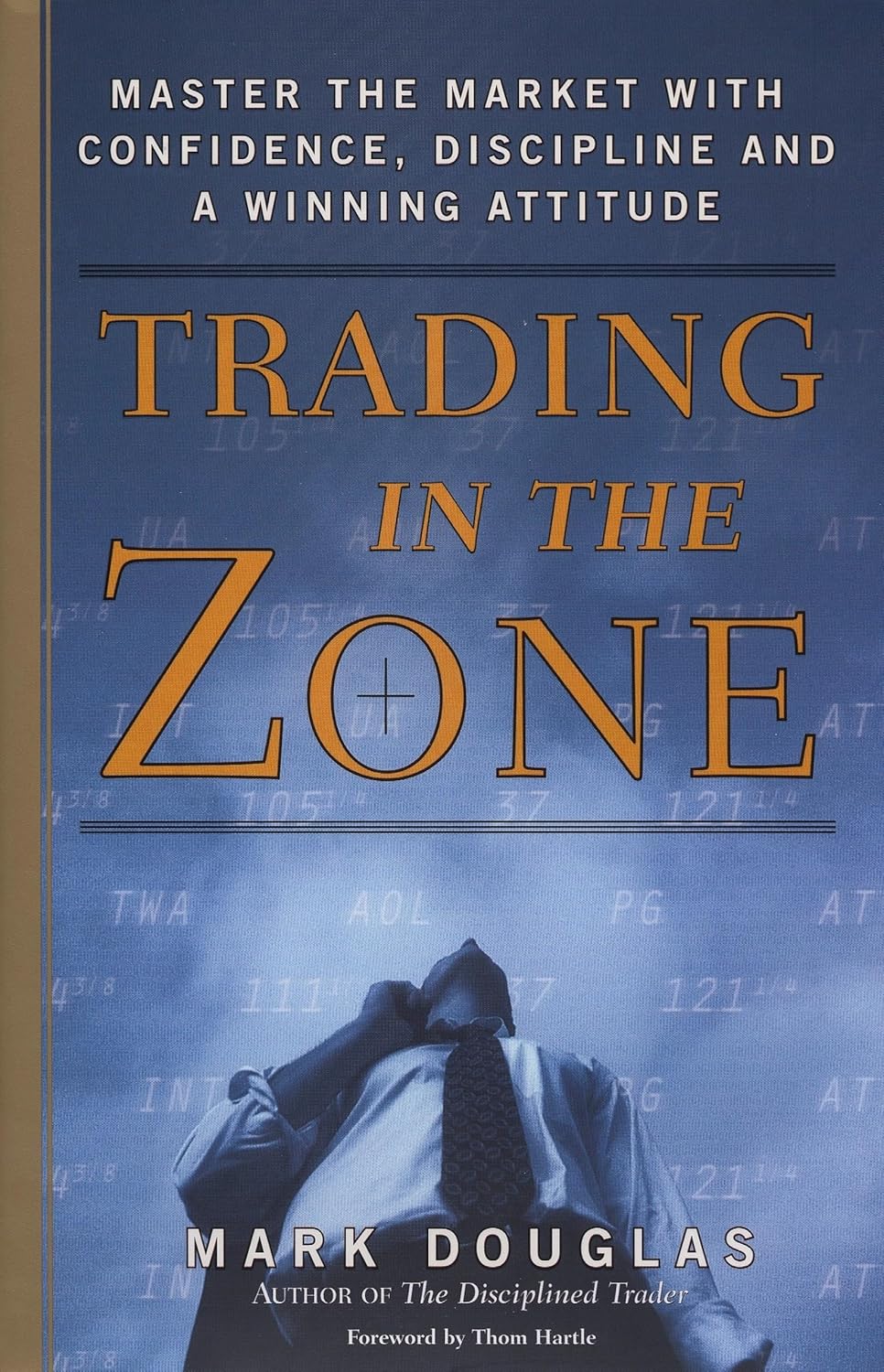
None of this is original to me. The framework behind every fix on this page is Mark Douglas’s Trading in the Zone: Master the Market with Confidence, Discipline and a Winning Attitude. His core argument is that you don’t need to predict the next candle — you need to think in probabilities and accept that any single trade can lose without your edge being broken. It’s the book everyone points new traders to, and in this case the hype holds up. I own it, I’ve read it, and I rated it 5/5.
Affiliate link — I may earn a small commission at no cost to you. I only recommend what I’ve actually read or use.
Want my full read on it and the rest of the list? See my Trading in the Zone review and every trading book I’ve reviewed.
What is trading psychology?
Trading psychology is how your emotions and mental habits shape your trading decisions — especially under stress. It covers how you react to a loss, whether you can sit out a bad day, and what a winning streak does to your risk-taking. Most traders lose money not from bad analysis but from letting fear, greed, and the need to be right override their own plan.
Why do traders hold on to losing trades?
Because taking a loss means admitting you were wrong, and the human brain treats that as a threat. So traders “bag hold” — they keep a red position and hunt for reasons it will come back, rather than take the small planned loss. The fix is to decide your exit before you enter and treat that stop as non-negotiable, so the decision is made before the emotion arrives.
How do I stop revenge trading?
Recognize the urge for what it is: the next trade being about the last one instead of the chart. The most reliable fix is a hard rule — step away from the screen after a loss, and cap how many trades or how much you’ll risk in a session. The market doesn’t know you’re down and won’t hand the money back, so forcing a trade to “get even” usually just doubles the loss.
How do I get over FOMO in trading?
Require a plan before every entry. If you can’t state your entry, stop, and target before you click, you’re acting on fear of missing out, not on a setup — so you pass. It helps to remember there is always another trade; the move you’re afraid to miss is never the last opportunity the market will offer. A missed entry costs nothing. A chased one costs real money.
Some links on this page — the book link and the Position Size Calculator’s recommended tools — are affiliate links, meaning I may earn a small commission at no extra cost to you. I only recommend what I’ve actually read or use. Nothing on this page is financial or investment advice, or a trade signal — it’s educational content about process and psychology. Full affiliate disclosure →
Find out how you actually react under pressure.
Take the Trading Psychology QuizDid you find this helpful? Join the list and I’ll keep you in the loop as I add more tools and guides — no spam, unsubscribe anytime.
I store your email (and name if you add it). Nothing else. Unsubscribe anytime.